Converting the World's Urinals to Operating without Water
Published by Water Network Research, Official research team of The Water Network in Technology
There are seventy-five million urinals installed in the world today. Each one, on average, is flushed at least three times a day. Assuming no leaks and perfect efficiency, urinals use a gallon per flush. Simple math leads to understand that urinals use up about a quarter of a billion gallons of water every day.
One person looking for a solution to water scarcity via free market forces is Simon Davis, a business executive focused on converting the world's urinals to operating without water. Davis is the CEO of Falcon Water Free Technologies, a company founded by Jeff Skoll and Marc Nathanson, two rich guys with a passionate interest in making the world a better place, but who understand that market forces can be used to achieve that. If they each get rewarded with financial gains for their effort and risk, they won't complain, even if that may not have been their initial or primary motivation.
In just a few years, Falcon, which markets its products in partnership with Sloan, and other urinal manufacturers like Duravit and Kohler, have installed about two million water-free urinals, a small dent in the total, but still representing six million gallons of water saved daily that until recently would be wasted.
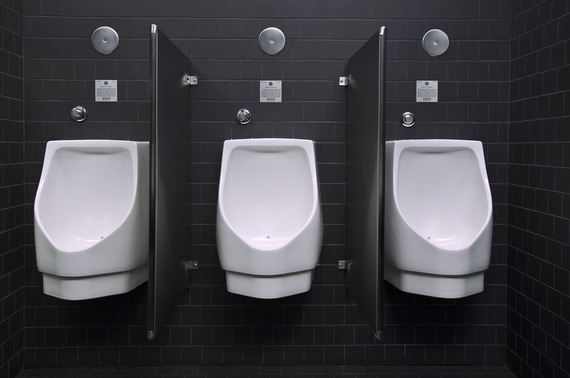
It will take a generation--with new construction and office and public facility renovations leading the way--for the global replacement of familiar water-flushed urinals to be completed. Still, the trend line is unmistakable. And even more important, what is happening in urinals will also happen with other household and commercial appliances.
Falcon itself has a water-saving idea for sinks in office and public restrooms that would eliminate leaving the water running while reaching for the liquid soap. The Falcon sink allows the user to moisten his or her hands, automatically stops the water, and then drops a dab of soap. After allowing a moment to spread the soap, the water flow resumes until it is shut off again and a paper towel drops down.
Others are working on hyper-efficient toilets, showers, dishwashers and washing machines. I hope to profile some of these in upcoming posts.
What is so smart about the inventors and marketers of these new devices beyond the technology they employ is that these water-efficient appliances give consumers the opportunity to continue to enjoy their lives in a familiar way and with no less comfort, but with large water savings. In the aggregate, the savings will be enormous, even transformative. The devices may be evolutionary, but the effect will be revolutionary.
Source: Huffington Post
Read More Related Content On This Topic - Click Here
Tags
Category: Technology
- Technology
- Clean Tech
- Conservation
- Green Technology
- Water