Inside Cambrian's Water-as-a-Service Financing Model
Published by Water Network Research, Official research team of The Water Network in Business
Matt Silver, CEO of Cambrian Innovation, hired a team of financial whizzes to figure out how to make it far simpler to buy his company’s EcoVolt technology.

One of the most common observations fielded by wastewater treatment startup Cambrian Innovation after sales visits with prospective customers: "If you could only install this and operate this for us, we’d be ready to go."
Founder and CEO Matt Silver took those comments to heart. Over the past six years, he quietly hired a team of financial whizzes to figure out how to make it far simpler to buy his company’s EcoVolt technology, a system that cleans industrial wastewater and converts the recovered materials into renewable biogas.
The result: a financing model that borrows from the principles of the power purchase agreements that many corporate renewable buyers are using to invest in solar and wind power resources. Cambrian calls its financing option a water-energy purchase agreement, or WEPA, if you prefer. It launched a $30 million fund in late 2015 to invest in the idea.
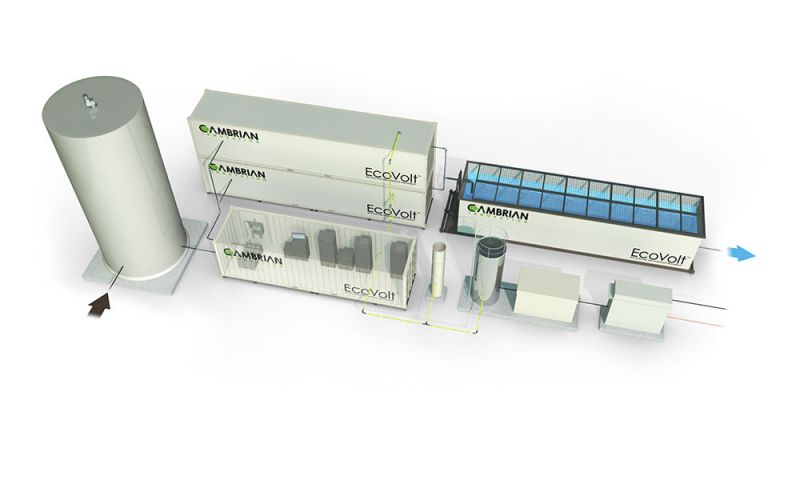
The Ecovolt® Solution
Let’s be flexible
Many of Cambrian’s early customers come from the craft beer and wine industries in California, where the drought has made creativity about water conservation and management a priority. The company said that it has treated more than 15 million gallons of water (so far) for the sector.
The terms of the Lagunitas WEPA contract won’t necessarily be right for everyone; for example, Silver expects most relationships to be 10 years long, rather than the 20-year term that Lagunitas opted to negotiate.
Many of Cambrian’s early customers come from the craft beer and wine industries in California, where the drought has made creativity about water conservation and management a priority.
The length will depend, in large part, on whether a company takes advantage of utility-sponsored financing options or state or government tax rebates and other financial support.
Examples are the California Public Utility Commission’s Self-Generation Incentive Program or the U.S. Environmental Protection Agency’s new $1 billion credit vehicle, the Water Infrastructure Finance and Innovation (WIFIA) program. That resource is meant generally for projects at $20 million in size, according to the EPA. The general focus of this project — as well as the new administration’s interest in supporting new infrastructure buildouts — give one hope that WIFIA has a chance of surviving under the new president.
Part of Cambrian’s value proposition is its extensive knowledge about how to use these programs to a customer’s best advantage, but they’re not necessary to make an EcoVolt a worthwhile option.
“They’re not required to make the project economical, but they help," said Silver.
Source: Green Biz
Tags
Category: Business
- Business Development
- Market Research
- Technology
- Business Strategy
- Water Management
- Business Studies
- Biogas
- Biogas Plants