Almost Frictionless Water Flow Through Carbon Nanotubes
Published by Water Network Research, Official research team of The Water Network in Academic
Frictionless water flow through carbon nanotubes will advance the applications in desalination and water purification technologies.
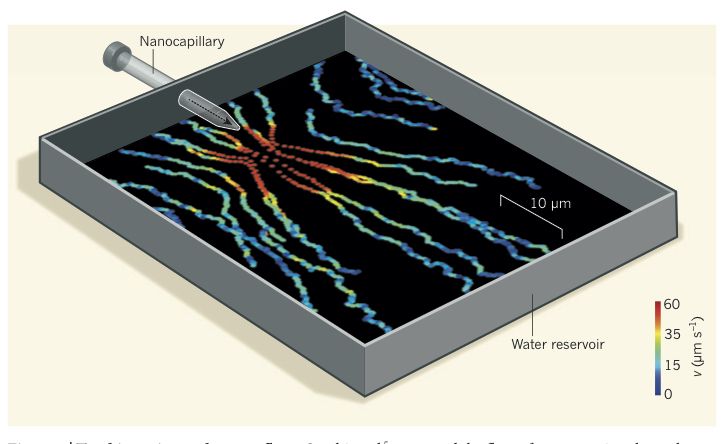 Water flows almost without any friction through carbon nanotubes and the smaller the tubes, the slipperier their insides are.
These new findings from researchers at the Laboratory of Statistical Physics at ENS in Paris, France, will be important for advancing fundamental studies on these nanostructures as well as for applications in desalination and water purification technologies.
“This is the first time that these effects have been demonstrated in an experiment,” says team leader Lydéric Bouquet.
“We predicted these theoretically a few years back with my colleague Roland Netz, but the experimental observations are far stronger than expected.”
Carbon nanotubes (CNTs) are sheets of carbon just one atom thick that have been rolled up into a tube with a diameter of about 1 nm. Researchers have suggested that water should flow through these nanostructures at speeds much greater than those predicted by classical theories.
However, measuring such flow speeds is difficult to say the least, so these predictions have been impossible to confirm or refute and have even met with a certain amount of scepticism.
Towards improved membranes and nanofluidic devices
Angelos Michaelides at the London Centre for Nanotechnology at University College London, who was not involved in this work, comments on the new findings in a related Nature News & Views article. “By providing a deeper understanding of well defined aqueous interfaces, these measurements might aid the design of improved membranes and nanofluidic devices,” he writes.
“The results also create opportunities and challenges for computer simulations of fluid motion. This is important because understanding how well computers simulate interfacial water is relevant not just to potential applications such as membranes and water desalination, but also to fields such as the atmospheric sciences, energy production and storage, and catalysis.
“To extend this work for desalination applications, it will be essential to understand the connection between water flow and (salt) ion motion (water can travel much more rapidly through these tiniest of pipes than, for example, salt ions can). More broadly, the authors’ experimental approach could readily be applied to nanofluidics in general, by examining the flow of different liquids through different materials.”
The ENS researchers say that they would like to study liquid flow across biological nanopores, such as the aquaporin protein, which is a very efficient water filter. “Such experiments are now within reach,” says Bocquet.
Read full report at: Nano Tech Web
Tags
Category: Academic
- Treatment
- Membranes
- Nanotechnology
- Nano Materials
- Desalination
- Nano
- Nano Technology