Carbon Nanotubes Worth Their Salt
Published by Water Network Research, Official research team of The Water Network in Academic
Lawrence Livermore (LLNL) scientists, in collaboration with researchers at Northeastern University, have developed carbon nanotube pores that can exclude salt from seawater.
The team also found that water permeability in carbon nanotubes (CNTs) with diameters smaller than a nanometer (0.8 nm) exceeds that of wider carbon nanotubes by an order of magnitude.
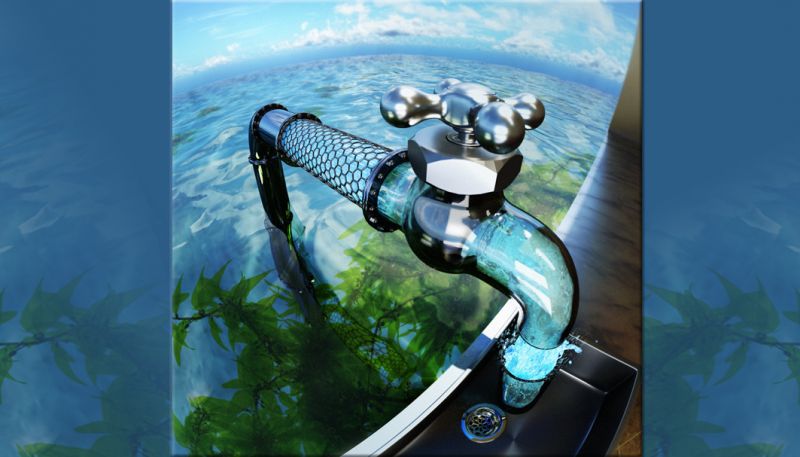
An artist’s depiction of the promise of carbon nanotube porins for desalination. The image depicts a stylized carbon nanotube pipe that delivers clean desalinated water from the ocean to a kitchen tap. Credit: Ryan Chen/LLNL
The nanotubes, hollow structures made of carbon atoms in a unique arrangement, are more than 50,000 times thinner than a human hair. The super smooth inner surface of the nanotube is responsible for their remarkably high water permeability, while the tiny pore size blocks larger salt ions.
Increasing demands for fresh water pose a global threat to sustainable development, resulting in water scarcity for 4 billion people. Current water purification technologies can benefit from the development of membranes with specialized pores that mimic highly efficient and water selective biological proteins.
"We found that carbon nanotubes with diameters smaller than a nanometer bear a key structural feature that enables enhanced transport. The narrow hydrophobic channel forces water to translocate in a single-file arrangement, a phenomenon similar to that found in the most efficient biological water transporters," said Ramya Tunuguntla, an LLNL postdoctoral researcher and co-author of the paper, appearing in the Aug. 24 edition of Science.
Computer simulations and experimental studies of water transport through CNTs with diameters larger than 1 nm showed enhanced water flow, but did not match the transport efficiency of biological proteins and did not separate salt efficiently, especially at higher salinities. The key breakthrough achieved by the LLNL team was to use smaller-diameter nanotubes that delivered the required boost in performance.
"These studies revealed the details of the water transport mechanism and showed that rational manipulation of these parameters can enhance pore efficiency," said Meni Wanunu, a physics professor at Northeastern University and co-author on the study.
"Carbon nanotubes are a unique platform for studying molecular transport and nanofluidics," said Alex Noy, LLNL principal investigator on the CNT project and a senior author on the paper. "Their sub-nanometer size, atomically smooth surfaces and similarity to cellular water transport channels make them exceptionally suited for this purpose, and it is very exciting to make a synthetic water channel that performs better than nature's own."
This discovery by the LLNL scientists and their colleagues has clear implications for the next generation of water purification technologies and will spur a renewed interest in development of the next generation of high-flux membranes.
Read full article: LLNL
Tags
Category: Academic
- Treatment
- Treatment Methods
- Nanotechnology
- Nano Materials
- Desalination
- Sustainable Desalination
- water treatment
- Desalination
- Nanotubes
1 Comment
Dear Ladies and Gentlemen members of Lawrence Livermore National Lab and NorthEastern University researchers,
You are supposed to be a source of knowledge, and your light will enlighten others and not the opposite. Great that you are imitating a natural phenomenon. A much easier natural phenomenon is how most of world population is getting their tap water in their residence and everywhere else. The world population is mainly dependent on the natural phenomenon of room temperature evaporation from the surface of seas and oceans, next the formation of clouds, next raining and the collection of potable water in rivers.
The main source of our distressful water shortages is mainly due to the ignorant mental capacity of human beings of this civilization, who are totally unaware Who is the main Provider of more than 95% of tap water all over the whole world. Dear scientists and researchers (there is no need to describe your behavior). I am getting totally lost how to define the mental capacity of our civilization: (there is no need to go into more details)
The solution is much, much easier than your nanotubes, simply imitate room temperature evaporation, next condense evaporated water. If interested we have a complete website at your service naturalseawaterdesalination.com. Luckily, luckily we did not patent our design for the welfare of this poor civilization, our design is available totally free, we are not charging anyone, just do the same.
Published by Maher Louis, PE, PEng., Senior Process Engineer at Clairmonte Processes