Desalination Breakthrough: Saving the Sea from Salt
Published by Water Network Research, Official research team of The Water Network in Technology
A chemist finds a way to cut supersalty discharge and CO2 as the Middle East relies ever more on seawater desalination.
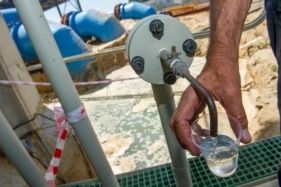
A glass of drinking water at the IDE Technologies Sorek Desalination Plant in Israel. Credit: Ann Hermes/The Christian Science Monitor via Getty Images
Farid Benyahia wants to solve two environmental problems at once: excess carbon dioxide in the atmosphere and excess salt in the Persian Gulf (aka the Arabian Gulf).
Oil and natural gas drive the region’s booming economies—hence the excess CO2—and desalination supplies the vast majority of drinking water, a process that creates concentrated brine waste that is usually dumped back into the gulf.
Benyahia, a chemical engineer at Qatar University, thinks he may have hit on a neatly efficient way to address the problem. “The goal is to solve two nasty environmental problems with one smart solution and generate useful, marketable products to offset partially the cost of storing CO2,” he says.
The secret is a variant of the Solvay process, a 150-year-old, seven-step chemical conversion method that is widely used to produce sodium carbonate for industrial applications, and that many chemists are working to refine. Benyahia has simplified the process in part by aiming for sodium bicarbonate (baking soda) rather than sodium carbonate, thus reducing the needed chemical conversion steps to just two.
In the presence of ammonia he reacts pure carbon dioxide with the waste brine from desalination, creating solid baking soda and ammonium chloride solution. In a second step he reacts the ammonium chloride solution with calcium oxide to produce calcium chloride solution and ammonia gas. Recovering the ammonia allows him to reuse it in the first step, reducing the cost of the process.
Benyahia’s process is unusual in that it reduces the need for brine disposal by nearly 100 percent, ending up with sodium bicarbonate, calcium chloride and ammonia for reuse in the first step. It also uses pure CO2, whereas other similar processes use flue gas from power plants—which is about 10 percent CO2 and contains other gases.
Using flue gas adds a step of separating out the pure CO2, making the process more expensive. Qatar already has natural gas processing plants venting pure CO2 close to brine disposal stations, making Benyahia's solution potentially cost-effective, at least in places with similar infrastructure.
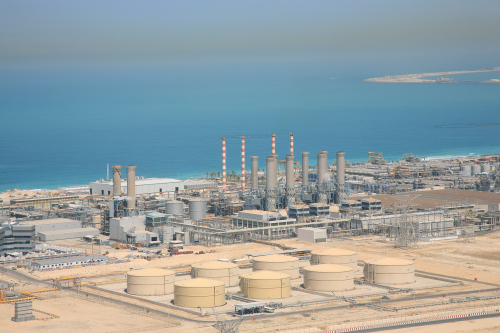 Brine disposal is a big problem in much of the Middle East. The gulf, along with the Red and Mediterranean seas, are turning saltier because of desalination by-products—and the region is the epicenter of desalination worldwide, with the United Arab Emirates, Saudi Arabia, Kuwait, Qatar, Bahrain and Oman making up 45 percent of global desalination capacity.
This brine is typically twice as salty as seawater, and advanced desalination plants still produce approximately two cubic meters of waste brine for every one cubic meter of clean water.
Also contributing to the increased salinity is the geography—these seas are largely enclosed, with low levels of water circulation—as well as decreased freshwater input from rivers including the Euphrates due to large-scale dams and diversions upstream. In some spots in the gulf salinity doubled between 1996 and 2008 and is expected to more than double again by 2050.
“I believe that the estimated numbers of salt concentration at year 2050 will be even larger if the desalination projects continue at the same increment level today,” says Raed Bashitialshaaer, a water resources engineer at Lund University in Sweden who specializes in desalination. Desalination capacity in the gulf region is projected to nearly double between 2012 and 2030.
Brine dumping also threatens future drinking water supplies. “It’s harder to clean the water if it’s saltier,” Bashitialshaaer says, adding that the larger amount of energy required to do so and the need to change the membranes in reverse-osmosis plants more frequently increases the expense.
The gulf is already seeing lower yields of clean water produced from a specific amount of seawater—and higher costs. “I have studied up to 2050, including all planned plants for right now,” Bashitialshaaer says. “If they continue like this in Arabian Gulf, it will be very difficult to continue.”
Read more on: Scientific American
Tags
Category: Technology
- Treatment
- RO Systems
- Reverse Osmosis
- Desalination
- Reverse Osmosis
- Brine Discharge Modeling & Analysis
- Desalination Plant
- Zero Liquid Discharge plants
- Desalination