Fighting Against Saltwater Intruding
Published by Water Network Research, Official research team of The Water Network in Academic
New Technology Tested Along A Battle Line For Saltwater Intrusion
An innovative partnership led by the America’s Wetland Foundation is fighting on two fronts: against saltwater intruding up from the Gulf of Mexico threatening the Intracoastal, and against the Intracoastal itself eroding the surrounding marsh.
The Gulf Intracoastal Waterway has a levee like most in Louisiana—mud, piled high, with grass growing on it. America’s Wetland Foundation partnered with private landowners, non-profits and local businesses to try to stabilize that levee with a new technology called Vegetative EcoShield.
Ted Martin, founder of Martin Ecosystems, the manufacturer of Vegetative Ecoshield, holds a model showing what the product looks like installed on top of a shoreline. A few strips of wire mesh lay across an angled piece of Styrofoam with little sprigs of plastic grass sticking out.
Basically it’s a turf-like product laid down along the shoreline, part in the water and part along the levee. That wire mesh matrix is made of recycled PET plastic waterbottles, says Martin's daughter and president of Martin Ecosystems, Nicole Waguespack.
"When we plant the plants into the matrix, the root system of the plants feed through," she says. "They get intertwined all throughout with the matrix material itself. So the material provides an anchoring for the plant."
Anchoring plants into the material before the matrix is laid down on the marsh is an important step. Just shoving plants into the marsh has not worked.
" If a hurricane comes they may get washed away," she says. "What the matrix does is it allows the plants something to grab onto."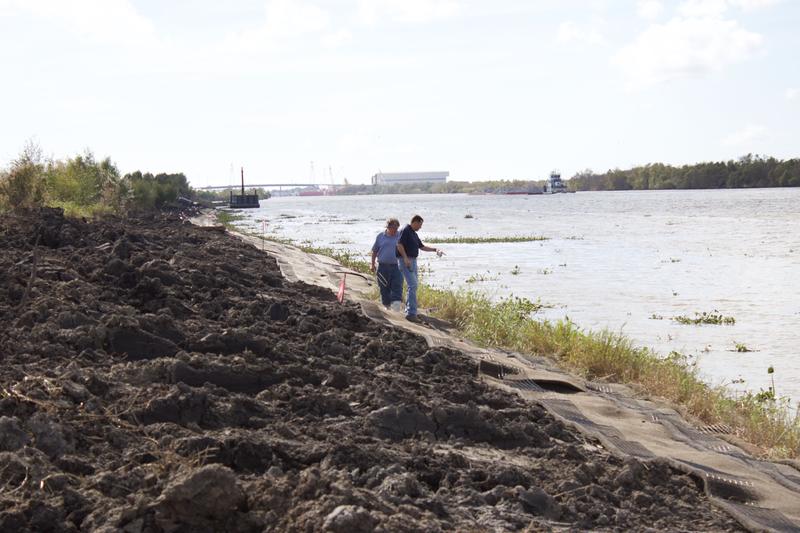
We motor out to the restoration site, a one-mile long stretch of levee about 50 feet wide and six feet tall. The land being restored is owned by Louisiana Delta Farms. The property borders the Intracoastal on one side, with the rest surrounded by marsh. Before partnering with America’s Wetlands, Delta Farms spent over half a million dollars on preventing the Intracoastal from scouring out the bottom of the levee.
Delta Farms surface manager Lynn Melancon says every week, more or less, the company would have to return and rebuild something. "And add three to four feet to our footage in a week!" he says. " It’s unreal!"
The company has been adding back high quality mud, to no avail.
"This material is actually harder than the marsh...I mean, look, this is good material, " he says, what they call 'blackjack.' "But where the marsh erodes," he says, "it erodes in front your eyes, feet!"
The Intracoastal eroding its own levee is just one problem. There’s been so much land loss from the coast up toward the intracoastal, salt water intrusion is a growing concern. John Heatherwick works for the wildlife habitat conservation non-profit Ducks Unlimited, another project partner.
"Once the shoreline breaches and you get the salt water to come in, it degrades the marsh and it’s not good for anything," he says. "The freshwater marsh is so much more productive for ducks, fish, alligators, the whole gamut of wildlife. And once it’s gone, you can’t hardly get it back."
Source: WWNO
Read More Related Content On This Topic - Click Here
Tags
Category: Academic
- Technology
- Environment
- Solutions