New Standard In Forecasting Membrane Fouling Potential
Published by Water Network Research, Official research team of The Water Network in Technology
Recently, ASTM has approved a new standard test method for predictionof fouling tendency. For many years the ASTM D4189-95 (SDI) has been the standard to which prediction of fouling tendency is measured, the socalled SDI value in feed water to RO installations.
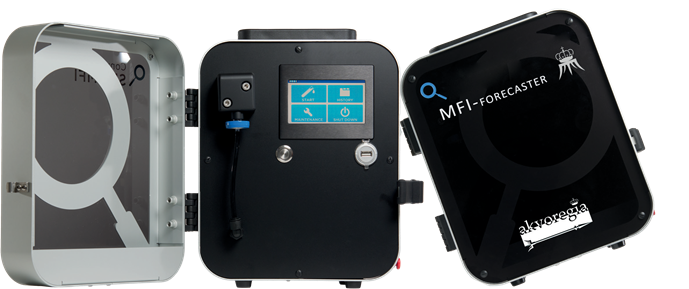
In November 2015, ASTM approved the Modified FoulingIndex (MFI-0.45) as a new standard test method (ASTM D8002-15). This is a good step forward as prediction of thefouling tendency based on MFI is more accurate. The MFI-Forecaster of Akvoregia, a portable instrument, can easilymeasure the ASTM standardized MFI-0.45.
Why a new standard?
The SDI is widely used for many years, but the results are questionable. Colloids and particles are the main cause for plugging and clogging of membranes. The absence of a linear relation between colloidal matter and particles is a major limitation of the SDI test.
The Modified Fouling Index 0.45 has been developed for this reason. The principle of cake/gel layer formation on a membrane is used for this index. The index empirically correlates with colloidal and suspended matter, and also includes the contribution to fouling by particles smaller than 0.45 µm. The outcome of the MFI-0.45 test gives a much more reliable forecast of the fouling tendency for RO-systems. The MFI-Forecaster is for engineers and operators of RO-systems a ‘must have’ to determine the effectiveness of their pre-treatment processes.
The MFI-0.45 test is also applicable in other processes like clarification, to determinethe effectiveness of particle removal. Another application lies in the field of geothermal energy, i.e. to forecast the risk of plugging groundwater wells and infiltration sources.
Why measure the fouling potential?
As a consequence of a filtration process a cake/gel layer builds up on the membrane area and disturbs the flow distribution in the membranes. This directly influences the process performance negatively, the permeability will decrease and by that the productivity of the membranes. This leads
- increase of energy consumption during filtration
- increase of cleaning frequency
- decrease of production time
- decrease of membrane lifetime due to more frequent cleaning.
When the fouling potential is frequently measured, a good understanding of the process performance can be build up, based on a reliable dataset. This then gives engineers and operators the opportunity to take preventive measures and optimize the process performance with minimal costs.
How to measure the MFI-045?
The simple, portable and battery powered MFI-Forecaster offers the opportunity to measure the MFI-0.45 on any location no matter the turbidity of the water. The MFI-Forecaster can measure both SDI and MFI-0.45, which is a huge plus and makes it easy to become familiar with the new standardized MFI. The instrument is easy to use and operate and results can conveniently be stored on a USB stick. This enables the user to build up his own, reliable database. A significant reduction of up to 50% can be achieved in the cost of testing.
More information?
The MFI-Forecaster is offered by Akvoregia, who has been involved from the beginning of the development of the MFI-0.45. An intensive co-operation was sought with research institutes to come to the MFI-0.45 standard. Based on our experience in membrane technology and the inevitable fouling topics, we recognized the importance of the fundamentally new fouling index. Therefore, Akvoregia congratulates the industry of membrane filtration with the ASTM approval of the MFI-0.45
For more information about the new ASTM MFI-0.45 standard or a quotation of the MFI-Forecaster, please send an email to MFI045@akvoregia.eu or visit the website www.akvoregia.eu
Source: Akvoregia
Read More Related Content On This Topic - Click Here
Tags
Category: Technology
- Membrane Bioreactor Systems
- Membrane Technology
- Membrane Filtration