3D-printed Feed Spacers for Membrane Systems
Published on by Water Network Research, Official research team of The Water Network in Technology
Water: Without interference by humans, it’s meant to be a pure substance that makes up around 70 percent of the Earth, with most of it contained in the oceans
We enjoy the beauty of water in many different states, from cascading waterfalls to the still pond that allows us to skip stones—to a fun family day at the beach or out fishing for flounder in a bay or on the ocean in our boat. While that may all seem fairly simple, sustenance is the biggest priority regarding our relationship with water, and that’s a very complex subject. Water—and our need for it—is also big business around the world regarding numerous processes and methods for working to make it accessible to everyone, as well as filtering and purifying, so that we don’t get sick from the very thing that is ultimately supposed to act as our life force.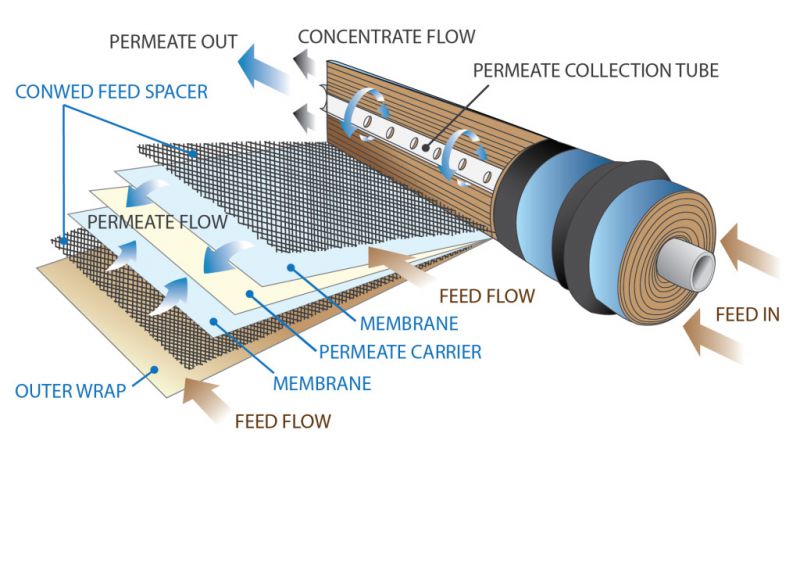
Companies such as Conwed, headquartered in Minneapolis, are dedicated to providing very necessary components to the water filtration and reverse osmosis (RO) industry. They are also known as pioneers in the use of 3D printing for items like their feed spacers—parts which serve to allow for uniform water flow in membranes for complex structures like spiral-wound reverse osmosis (RO) and nanofiltration (NF) membrane systems.
Conwed’s specialty though is in manufacturing and selling plastic netting around the world. Recently, this global industry leader also helped with a water research study by providing their 3D printed spacers for research comparison.
The study, led by researchers from both Saudi Arabia and the Netherlands, was the subject of a recently published paper, ‘Development and characterization of 3D-printed feed spacers for spiral wound membrane systems.’ found in Water Research 91 (2016) 55-67, and authored by Amber Siddiqui, Nadia Farhat, Szilárd S. Bucs, Rodrigo Valladares Linares, Cristian Picioreanu, Joop C. Kruithof, Mark C.M. van Loosdrecht. James Kidwell, and Johannes S. Vrouwenvelder.
The study offers a new strategy for dealing with biofouling, an issue which spans numerous sectors where components are subjected to ongoing exposure to water and therefore suffer performance issues due to accumulation of microorganisms, plants, or animals on their surfaces. The objective of this particular study was to develop, characterize, and test feed spacers with numerical modeling, 3D printing, and experimental membrane fouling simulator (MFS) studies.
The topic and impending research were sparked off by the idea that indeed hydrodynamics and biofouling issues could be improved on with better feed spacers. Due to the efforts Conwed is famous for within the RO industry, as well as being known for manufacturing a full line of diverse RO feed spacers, they were asked to collaborate with the researchers. Conwed has a deep commitment to not only providing desalination materials, but also finding ways to improve the corresponding systems
Due to their use of 3D printing, Conwed is known as an innovator within their industry. They’ve experimented with 3D printed spacers on a small scale so far, but this has allowed for much more expedient research and development of new designs that simulate conditions that would actually be found in desalination facilities. With 3D printing, they’ve been working with a range of scientists to see how they can impact issues of:
- Biofouling
- Membrane damage
- Pressure drop
Use of Conwed’s 3D printed feed spacers was crucial to the study by researchers as they were comparing both 3D printed and commercial feed spacers with both identical and different geometries. It’s also interesting to note that the Conwed team had already observed differences in performance when spacer specifications like width, angle, and chemical makeup were modified.
Read More Related Content On This Topic - Click Here
Media
Taxonomy
- Technology
- Membranes
- 3D Graphics