GCC Water Strategy Gathers Pace As Groundwater Use Falls
Published by Water Network Research, Official research team of The Water Network in Academic

Hail, KSA (Source: Njdaoi , Flickr)
Author: Fanack Water Editorial Team
The Gulf Cooperation Council is shifting its water model. New data show a 3 percent decline in annual groundwater extraction over nine years, while renewable water sources rose to 25.5 percent of the region’s water mix in 2024.
A Deliberate Shift In Supply
That change matters because groundwater has long carried the burden of demand across one of the world’s driest regions. The GCC’s latest numbers suggest governments are moving from dependence on finite aquifers toward a more diversified supply system built around desalination, treated wastewater reuse, and efficiency upgrades. This is not just an environmental adjustment; it is a strategic response to urban growth, industrial expansion, and food security needs.
The timing is important. Climate change is expected to intensify water stress in arid regions, and the UN has warned that global water demand could rise sharply by mid-century. In that context, the Gulf’s water investments are part of a broader effort to protect economic planning from future supply shocks.
Desalination As Backbone
Desalination remains the backbone of the region’s water security. Gulf states already account for a major share of global desalination capacity, and new projects continue to be announced as part of national development plans. The technology has become more efficient and less costly over time, helping governments scale supply in ways that were not feasible decades ago.
Still, desalination is not a standalone solution. It is energy intensive and can create environmental pressures if brine and emissions are not managed carefully. That is why many Gulf strategies now pair desalination with conservation, smarter networks, and reuse of treated wastewater.
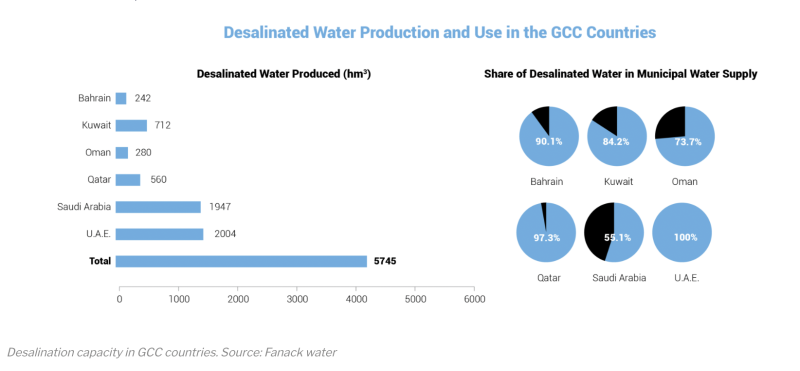
Desalination capacity in GCC countries. Source: Fanack water
Wastewater And Efficiency
Treated wastewater is gaining ground as a practical water source. Across the MENA region, reuse is increasingly seen as a way to reduce pressure on aquifers while supporting agriculture, landscaping, and groundwater recharge. In the GCC, this shift reflects a wider move toward circular water management, where water is used more than once before it leaves the system.
Efficiency is the other side of the equation. Reducing leakage, improving network performance, and deploying digital monitoring can all stretch available supplies without requiring a matching rise in production. For a region facing strong demand growth, this is often the cheapest “new” source of water.
What The Numbers Mean
The 3 percent drop in groundwater extraction is modest, but it points in the right direction. Groundwater is still vital in the GCC, especially for agriculture, yet overuse can quickly undermine long-term resilience. A gradual decline in pumping, combined with higher renewable-water shares, indicates that policy and investment are starting to align more closely with resource limits.
That said, the region’s challenge is not solved. Water security in the Gulf will depend on whether governments can keep expanding alternative supplies while also curbing demand and protecting aquifers. The latest data show progress, but also the scale of the task ahead.
References
- GCC Statistical Center – Water Statistics in the GCC
- Arab News – GCC ramps up water investments as groundwater extraction falls 3%
- GCC-Stat / Zawya – Gulf states increase renewable water use amid water security push
- World Bank – From Scarcity to Sustainability: The GCC’s Journey Towards Water Security
- Fanack Water – Desalination in the Gulf: A Double-Edged Sword for Water Security
- Fanack Water – Advancing Wastewater Reuse for Water Security in MENA
- Fanack Water – Groundwater Dependence in MENA: Risks, Realities, and Responses
Tags
Category: Academic
- Groundwater
- Water Security
- Desalination
- Water Security
- Water Security
- Security