New Study Calls for Careful Consideration When Planning Dams and Reservoirs
Published on by Water Network Research, Official research team of The Water Network in Academic
Drought scientists argue that while many dams and reservoirs are built, or expanded to alleviate droughts and water shortages, they can paradoxically contribute to making them worse.
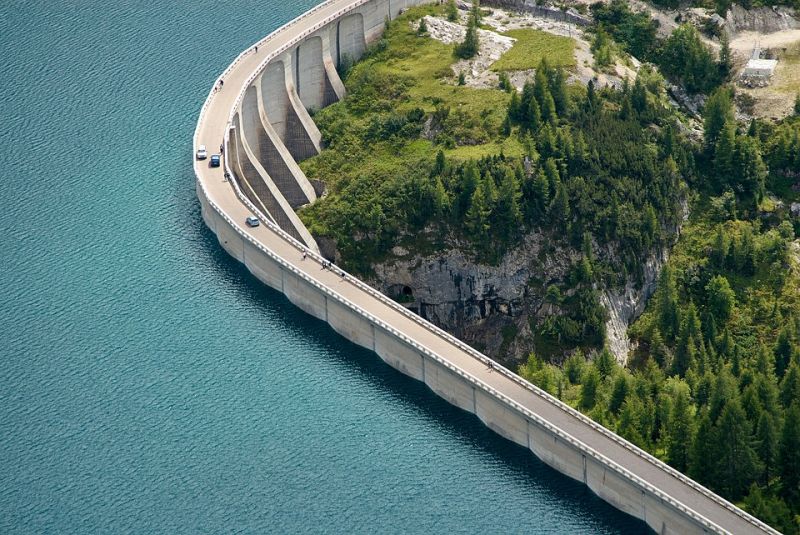
Representative Image Source: Pixabay, labeled for reuse
A team of ten drought scientists, including the University of Birmingham, argues that while many dams and reservoirs are built, or expanded to alleviate droughts and water shortages, they can paradoxically contribute to make them worse. This perspective paper is published in the journal Nature Sustainability.
Building dams and reservoirs is one of the most common approaches to cope with drought and water shortage. The aim is straightforward: reservoirs can store water during wet periods, and then release it during dry periods. As such, they can stabilize water availability, thereby satisfying water demand and alleviating water shortage. However, the paper shows that increasing reservoir storage capacity can also lead to unintended effects in the long term, and, paradoxically, worsen water shortage.
The authors argue that there are two counterintuitive phenomena that should be considered when expanding or planning reservoirs: the supply-demand cycle and the reservoir effect.
The supply-demand cycle describes cases where increasing water supply leads to higher water demand, which can quickly offset the initial benefits of reservoirs. These cycles can be seen as a rebound effect, also known in environmental economics as Jevon’s paradox: as more water is available, water consumption tends to increase. This can result in a vicious cycle: a new water shortage can be addressed by further expansion of reservoir storage to increase (again) water availability, which enables more water consumption, until the next shortage. As such, the supply-demand cycle can trigger an accelerating spiral towards unsustainable exploitation of water resources and environmental degradation.
The reservoir effect describes cases where over-reliance on reservoirs increases the potential damage caused by drought and water shortage. The expansion of reservoirs often reduces incentives for preparedness and adaptive actions, increasing the negative impacts of water shortage. Moreover, extended periods of abundant water supply supported by reservoirs can generate higher dependence on water resources, which in turn increases social vulnerability and economic damage when water shortage eventually occurs.
The study led by Dr Giuliano Di Baldassarre from the University of Uppsala also provides policy implications. He said:
‘Attempts to increase water supply to cope with growing water demand, which is fueled by the increase in supply, is unsustainable. Hence, we suggest less reliance on large water infrastructure, such as dams and reservoirs, and more efforts in water conservation measures - in other words, coping with drought and water shortage by reducing water consumption, rather than fueling consumption by increasing water supply. While many water experts would agree with this general recommendation, numerous dams and reservoirs are still being built or proposed in many places around the world.’
Dr Anne Van Loon, from the University of Birmingham’s School of Geography, Earth and Environmental Sciences and co-author on the paper, said:
‘The notion that "we must increase water availability to satisfy a growing water demand" remains pervasive because there are major knowledge gaps in the study of the dynamics generated by the interplay of water, society and infrastructure. We propose a specific research agenda to unravel the long-term effects, including the unintended consequences of reservoirs, and other types of water infrastructure, on the distribution of water availability and demand.’
Dr Sally Rangecroft, from the University of Birmingham’s School of Geography, Earth and Environmental Sciences, said:
‘In the paper we show a number of cases of the proposed supply-demand cycle and reservoir effect happening around the world, from the Maja’s to Las Vegas and from Athens in Greece to Melbourne, Australia. These examples reveal that a social perspective of dealing with water shortage is crucial and research on feedbacks between water and society is paramount. At the University of Birmingham, we have an ongoing collaboration between human and physical geographers developing different approaches to solve the water problems that societies are facing and proposing sustainable solutions for the future.”
Reference:
Di Baldassarre, G., Wanders, N., AghaKouchak, A., Kuil, L., Rangecroft, S., Veldkamp, T.I.E., Garcia, M., van Oel, P.R., Breinl, K., and Van Loon A.F. "Water shortages worsened by reservoir effects", Nature Sustainability, November 208, DOI: https://doi.org/10.1038/s41893-018-0159-0
Source: University of Birmingham
Media
Taxonomy
- Water Scarcity
- Water Supply
- Hydrology
- Ecohydrology
- Drought
- Water Supply
- Water Supply & Drainage
- Water Supply Design
- Rural Area Water Supply
- Urban Water Supply
- Infrastructure
- Dams
- Reservoir
- Integrated Infrastructure
- Urban Water Infrastructure
- Infrastructure Management
- Hydrology
- Hydrological Automation
- Hydrologist
- Flood damage
- Hydrology Cycle
- Experimental Hydrology Models
- Infrastructure Providers
- green infrastructure
1 Comment
-
WATER, ELECTRIC ENERGY AND FLOOD
Ways of water conservation in rivers are based on the creation of bulky dams with flooding of large areas and the creation of hydroelectric power plants (HPP). Man-made reservoirs are built on all residential continents, occupying more and more large areas with the destruction of biota. For example, 280 hydroelectric power plants are under construction in South America. As stated in this article, “In front of the hydroelectric dam, a large reservoir was formed, containing 22 km of water and having a water surface area of 1045 square meters. km In Brazil, 24 electric generators were recently installed on the dam. The volume of water in the reservoir almost reaches 46 cubic kilometers, and the surface area of the water is 2430 square meters. km In Russia, a hydroelectric dam holds the mass of a large Krasnoyarsk reservoir, having a water surface area of approximately 2000 square meters. km. " The main trouble of all reservoirs is the risk of breaking through and destroying everything below the dams. No less trouble is that the biota disappears under the reservoir mirror, and with it, the mechanism of water conversion in the animal and plant worlds, accumulated over millions of years. The area of plant leaves alone is 3 to 4 times the area of the entire land. The size of it, not less than the area of the oceans - #597. This is an untouched land, now by 2015, this land remains 30%. Everything else is plowed up, dumped by dumps, rolled up with asphalt. The natural water path on land is movement along the biota food and plant paths. Humanity at an accelerating pace destroys recent natural ranges.
According to the latest theory on climate change presented in the article Water Circulation and Climate Change, flooding of territories is the destruction of organic and increasing artificial evaporation, which leads the planet to natural disasters and global catastrophe.
If you look at the river, we often hear and see water overflowing and devastating floods. The main cause of such flooding is shallowing of rivers. By nature, the water continuously washes away soil particles from the banks and places them on the bottom. To this was added the human factor - garbage, waste products, various items in the form of scrap - add a significant increase in raising the bottom. Statistics were not found, but, logically, it is the coastal territories of settlements that are more destroyed. Rubbish discharged into rivers and settlements forms “thrombi” - underwater dams along the stream of water in the beds along the cities and downstream. This is where most water comes out of the coast.
Rivers, with increasing bottom intensively change their channel, expand the floodplains and overflow. To avoid this, it is necessary to maintain depth, regularly remove sediment. But this is not the main thing, the main thing is that if we want to save the planet for our descendants, we must immediately begin to return to the water its natural functions.
One of the main elements of reducing artificial evaporation is the cessation of the construction of new hydropower plants with the flooding of areas and the release of all previously built reservoirs. This is the conclusion reached by Chinese experts of the Academy of Sciences of China.
In the USA, for example, over half a century, more than 250 unprofitable hydroelectric power plants were decommissioned (read about it here).
There is a brilliant invention of V.I. Bodyakina, which maintains the existing power generation of hydroelectric generators without dams. The pressure creates water moving in the pipes from the beginning of the reservoir with the rise to the former top of the dam.
It is necessary to fundamentally review the possibility of accumulation of water in rivers.
The accumulation of water for irrigation and selection for cities can be created by small dams. Considering the levels of rivers and their floodplains, we find a fairly large difference in the height of the water level in the river and the height of the banks of the floodplains. In essence, the narrow, winding river at the bottom of the floodplain is not normal. The entire area, periodically washed away by the spring waters for centuries, is a drying stone-sand bank, often overgrown with various plants, which at certain points of the meandering of the river are washed away and carried away along the stream. There are absolutely bare areas of floodplain without plants - only sand and stones. This state suggests that the floodplains can be used to accumulate water in the spring and consume I am in the summer. To do this, it is enough to build a dam in the given places with a height not exceeding the height of the floodplain coast. And fill it to the brim. Many such dams form a cascade of lakes with running water. Like the famous cascades on the Volga and other rivers with giant dams. Naturally, in the body of such dams, culverts are constructed for taking water, spawning fish, moving ships, and regulating levels in adjacent pools. It is also possible to install small hydropower plants operating at a small height difference. There are no problems with dam structures 5–20 meters high. The usual earth-moving and road equipment are used.
There are places where there is no floodplain, and in these places, the water overflows, often with floods. And floods in them come from the same reasons - silting and raising the bottom. On such sections of the river, there are stretches and rifts. So, these natural stretches should be deepened up to 10-30 meters, and the rapids - shoals rise to the level of the shores, also with the installation of culverts.
These works can be performed with existing dredging equipment. It is cumbersome, energy-intensive and requires sufficiently large labor costs. There are a number of inventions that allow you to carry out any dredging work and solve the tasks with minimal cost. Use mainly the flow of the river itself. The essence of inventions is described in these two articles: Prevention of Floods and New Hydro-Engineering.
All these inventions are made in the form of proprietary technology solutions and require research and development. Thus, it is possible to save water of the same volumes as in reservoirs with bulky dams, but without the risks of man-made disasters. In foothill and mountain rivers, a chain of lakes with adjustable pools can become an obstacle to mudflows, and the water surface, covering the narrow, blurred, disfigured multimeter in height, gorges among fir trees will adorn the mountain landscape. The river becomes a distributed water reservoir, which changes the regime of small and intermittent rivers. They can become navigable, they can generate electricity, and according to the ideas of V.I. Bodyakin, using pipes, it is possible to save the generators of existing hydroelectric stations without dams. Where there is no hydroelectric station, it is possible to create a micro-hydroelectric station, distributed along the entire length of the river.
In addition, new, unprecedented properties are added - all the rivers and even small ones become fish-breeding, with bridges in given places, the possibilities of organizing beaches, recreation areas. Small rivers become navigable, and will not dry out during dry periods. The management capabilities of culvert constructions will allow to exclude the movement of ice in the springtime, and, consequently, floods due to congestion and blockages. In the mountain rivers, a new strategy of protection is being created.
An important, if not paramount, factor in reducing political tensions in the world, if such a concept is adopted, will be that all transboundary rivers will no longer be problematic in terms of water distribution.