Wastewater Treatment: Moving Closer to the Source?
Published on by Barry Engel, Product management in Technology
Decentralized treatment shortens pipelines and lowers system pressures because treatment plants are closer to those being served.
Very cost effective and environmentally beneficial.
Ask most people where their wastewater should be treated and the answer will probably be “As far away from me as possible.”
From a practical standpoint, however, good reasons exist to site treatment plants close to the wastewater source. That helps to explain the growing popularity of so-called “decentralized” wastewater treatment. Advantages offered by the latest technologies include lower treatment costs and smaller treatment facility footprints, as well as a more pleasant sensory experience for people living and working nearby.
In the U.S., almost 90% of the population is served by “mega-facilities,” says Abhirabh Basu, water research associate at Lux Research Inc., a Boston-based technology research and advisory firm. Building and operating such facilities is expensive because they often must move water to and from disparate locations. This requires longer pipelines and also higher pressures that cause more breaks and leaks in the pipes.
Decentralized treatment, on the other hand, shortens pipelines and lowers system pressures because treatment plants are closer to those being served. Many decentralized facilities are currently serving smaller, remote communities where it would be expensive to connect to a centralized treatment plant, Basu says.
 Abhirabh Basu, Lux Research.According to Basu, decentralized treatment is most popular in developing nations that lack wastewater conveyance systems or drinking water pipelines going to far-off treatment facilities, or even within urban places. But the concept is catching on in the U.S. as well, particularly in industry.
“The cost of water is gradually increasing, so it’s become imperative for industries to reuse as much water as they can,” Basu says.
Treatment in a Cage
Among the decentralized treatment options, Basu favors two that target biologically degradable contaminants. One is the membrane aerated biofilm reactor (MABR), developed by Ireland-based OxyMem Ltd. Deployed in a modular cage, the MABR unit can serve as a standalone treatment system or as a building block for a larger system.
In common activated sludge (AS) treatment systems, the bacteria that attack contaminants float in the wastewater. But in the MABR, they are part of a biofilm ecosystem attached to an array of hollow-fiber membranes. As wastewater travels through the MABR, this fixed film consumes carbon- and nitrogen-based pollutants.
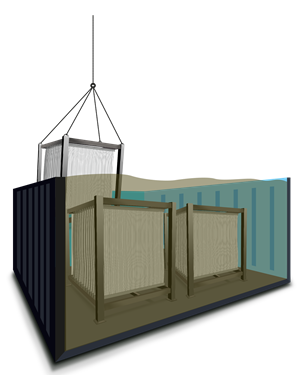 Upgrading a wastewater treatment plant with the OxyMem MABR. Image souruce: OxyMem.OxyMem says that slower-growing organisms that would normally be washed out of an AS tank--where bacteria are free-floating--are retained in the MABR. This results in a larger diversity of biomass to break down a wider variety of organic contaminants.
According to OxyMem, more than half the operating costs of a typical AS system are related to aeration, the process of adding air to wastewater to allow aerobic biodegrading of pollutants. AS treatment requires large amounts of energy to compress air at the bottom of aeration tanks.
Diffusers tap this air to produce bubbles that travel to the surface of the tanks and, in the process, transfer oxygen to the wastewater. But less than 30% of the oxygen supplied by diffusers is typically transferred to the wastewater, OxyMem says, so much of the energy consumed by the process is wasted.
By contrast, MABR’s gas-permeable membranes allow oxygen to be transferred directly to the wastewater-treating bacteria in the biofilm. As a result, OxyMem says its process can achieve oxygen transfer efficiency rates of up to 99%, potentially saving energy and cutting operating costs by up to 75%.
Another potential benefit of more efficient oxygen transfer is that MABR’s footprint is less than 20% that of a conventional AS system, says Eoin Syron, OxyMem’s technical director. This translates into savings in land costs as well as building materials and treatment equipment.
Launched in 2013, OxyMem now has about a dozen municipal and industrial clients in Europe, Japan, and Brazil. MABR users that fall into the “decentralized” category include firms in the food and beverage, pharmaceutical and semiconductor industries.
Bacteria Stay Put
Like the MABR, the other decentralized treatment technology singled out by Lux Research’s Basu relies on fixed-in-place ecosystems rather than free-floating bacteria. Developed by Organica Water Inc., based in Princeton, N.J., the Food Chain Reactor (FCR) provides biological treatment that takes place in a series of large concrete basins, or “reactors.”
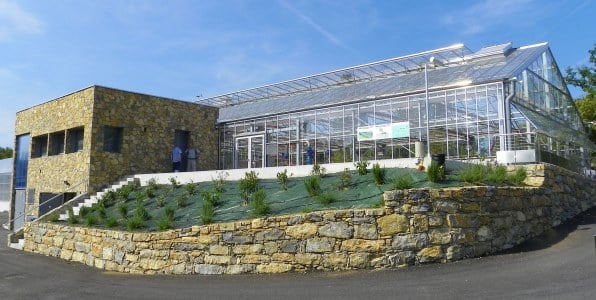 An FCR treatment facility. Image source: Organica.Sitting atop each reactor is a “biomodule” that holds plants whose roots reach into the water in the basin.
In addition, an engineered plant root system extends to the bottom of the reactor. Microorganisms live on the plant roots and Organica’s root-mimicking biofiber media form biofilm cultures that consume ammonia, nitrogen and other wastewater contaminants.
Organica FCR’s fixed-film carriers are home to up to 4,000 organism species arranged in a particular order. “The water starts out highly contaminated, so we start with microorganisms that enjoy an ammonia- and carbon-rich environment,” says Ari Raivetz, Organica’s CEO.
“As the water gets cleaner we employ microorganisms that enjoy less contamination. Or maybe they like to eat the guys from the earlier stages who were feeding on all that ammonia and carbon. That’s why we call it a food chain reactor.”
This food-chain arrangement produces an average of 30-40% less sludge than comparable AS treatment systems, Organica claims.
In addition, the company says that the FCR’s natural and engineered plant roots typically hold three to four times as many contaminant-consuming organisms in the same amount of space as an AS system. Therefore, Raivetz says, the system’s footprint is usually 50-60% smaller than a conventional AS plant handling the same amount and quality of wastewater. This, too, can result in land-cost savings.
With the majority of Organica FCR’s biomass attached to a root system, suspended solids concentrations are lower than those in AS water. Since oxygen transfer is more efficient in clearer water, less air is needed to keep Organica FCR’s ecosystems alive. As a result, its blowers use much less power than those in comparable AS plants. This can translate into 30% energy savings on average, the company claims.
Currently, more than 85 Organica treatment plants are operating or are under construction around the world. In industry, Organica FCR is used by food and beverage plants, as well as by slaughterhouses and pulp and paper facilities.
In many urban settings, the odor and unsightliness of conventional wastewater treatment plants would be problematic if not unacceptable. But with an attractive greenhouse design and none of the typical treatment plant odors (Organica recently modified the pebbles in its biomodule planting beds to improve odor removal), the FCR offers a significantly reduced “psychological footprint,” Organica claims.
“We are getting the most traction in large cities where they see that they can build localized treatment plants closer to where people live and minimize pipeline costs without impacting land value,” Raivetz says. Instead of building a conventional centralized activated sludge plant to take all the waste out of the city, the idea is to site two or three plants in the middle of the city.
Once the facilities are in place and functioning, he says, “you don’t know they are wastewater treatment plants. They look and smell like a garden.”
Attached link
http://insights.globalspec.com/article/3170/wastewater-treatment-moving-closer-to-the-sourceMedia
Taxonomy
- Governance & Planning
- Water & Wastewater
- Green Building
- Green Technology