Harmful Algal Blooms in Latin America: Lakes and Reservoirs
Published by Water Network Research, Official research team of The Water Network for LG Sonic in Case Studies
Harmful algal blooms in Latin America are no longer a summer problem for a few lakes. They affect beaches, river intakes and drinking water reservoirs from Mexico to Argentina, and they shape how utilities across the region run their water bodies. This guide explains why the blooms are rising, what the rules and alert levels say, how large lakes and reservoirs are monitored, and which control options exist. It then shows what was measured where ultrasound was used, with figures as reported by the utilities and regulators involved.
Key points
- Why blooms are rising. Nutrients from sewage and farmland, warm still water in reservoirs, dry seasons and El Niño years.
- Rules exist. The WHO alert level framework is applied by water authorities in the region, and Brazil’s ordinance moves utilities to weekly sampling above 10,000 cyanobacteria cells/mL and to toxin analysis above 20,000.
- Monitoring has changed. Continuous sensors, depth profiles and satellite images catch what weekly grab samples miss. Three operators in the region checked the sensor data against their laboratories.
- Options. Reduce nutrients at the source, manage the intake, mix where it helps, and treat in the lake with ultrasound. Chemical algaecides rupture cells and release toxins.
- Measured results. ANDA cut treatment chemical costs by $107,570.72 on the Río Lempa. Chlorophyll-a fell 87% at Valdesia. Microcystin fell 91.5% at Sabino in a CETESB pilot. LG Sonic systems run in 11 countries in the region.
- Where ultrasound fits. Lakes, reservoirs and intake basins deeper than 1 m. Swimming pools and koi ponds are not the scale of treatment, and fast, high-current rivers are not a suitable application. Ultrasound controls the algae that grow on the nutrients already stored in the lake, so it delivers results while catchment measures take their time.
Why are harmful algal blooms in Latin America increasing?
Nutrients and sanitation gaps
Most blooms start with nutrients. Untreated sewage, farm runoff and urban stormwater carry phosphorus and nitrogen into lakes and reservoirs, where cyanobacteria turn them into biomass. Researchers in Uruguay class the Río Negro reservoirs (Bonete, Baygorria and Palmar) as hypereutrophic, and toxic cyanobacteria blooms have been recorded both in the reservoirs and on the river’s beaches. In Managua, Tiscapa Lagoon carried the legacy of about four decades of discharges when the municipality began its restoration programme in 2022. Where sanitation lags, the nutrient load stays, and so does the bloom risk.
Warm, still water: reservoirs and dry seasons
Reservoirs for hydropower and water supply are common across South America, and a reservoir turns a moving river into warm, still water with a long residence time. That is what cyanobacteria prefer. The dry season adds low flows, clear water and strong sunlight. On the Río Lempa in El Salvador, the blooms arrive in the dry season, when water temperature climbs into the low 30s °C. In Brazil’s semi-arid Northeast, a study of supply reservoirs in Ceará found them dominated by cyanobacteria because eutrophication meets a hot, dry climate, and it expects more drought and more blooms as the climate shifts.
El Niño and the extreme year
Climate cycles make the bad years worse. EPM’s La Fe reservoir in Colombia met the 2015 to 2016 El Niño in its first year of ultrasound treatment. Argentina’s El Limón reservoir is a dry-season reserve that must hold supply when the rivers run low. So planning for harmful algal blooms in Latin America means planning for the extreme year, not the average one, and keeping an eye on the Río Negro, the Tietê and the Magdalena alike: large systems with many users and many sources of nutrients.
What is at stake for water supply and public use?
Four things, and they rarely come alone.
- Toxins. Some cyanobacteria produce microcystins, cylindrospermopsins and saxitoxins. The region’s reference case is Caruaru in Brazil, where patients at a dialysis clinic died in 1996 after exposure to microcystins. Brazil stepped up cyanobacteria and toxin monitoring after that event.
- Taste and odour. Geosmin and MIB are detected by customers at tiny concentrations. CEDAE in Rio de Janeiro dealt with geosmin complaints over two summers and then added source water measures for the nine million people it serves. See taste and odour in drinking water.
- Closed beaches and lost tourism. Sabino’s municipal beach on the Tietê was under swimming restrictions for 245 days in 2026. Salto Grande’s beaches at Federación have faced the same pressure, and Quillón acted early to protect Laguna Avendaño.
- Treatment cost. Blooms push up activated carbon, oxidant and coagulant dosing, and they clog filters. ANDA’s records on the Río Lempa show the scale: $107,570.72 less in treatment chemicals after it added source water control.
Which rules and alert levels apply in the region?
Two frameworks matter for harmful algal blooms in Latin America, and most national rules build on one of them.
The WHO alert level framework
The WHO guidance Toxic Cyanobacteria in Water (Chorus and Welker, 2021) sets out a vigilance level, Alert Level 1 and Alert Level 2, based on cyanobacteria biovolume, chlorophyll-a and toxin analysis. Water authorities in the region apply it directly. AUTODEMA in Peru, for example, uses a vigilance threshold of 200 cells/mL, Alert Level 1 at 0.3 mm³/L of biovolume and Alert Level 2 at 4.0 mm³/L for the reservoirs it operates. In Argentina, CONICET researchers frame cyanobacteria management as risk management: permanent preventive monitoring, clear alert levels and agreed actions, including for basins shared between provinces or countries.
Brazil’s drinking water ordinance
Brazil’s Portaria GM/MS 888/2021 sets the national drinking water standard. Under its rules, utilities count cyanobacteria at the intake monthly; above 10,000 cells/mL the count becomes weekly, and at 20,000 cells/mL or more they must also analyse cyanotoxins every week. For recreational water, CETESB in São Paulo state used a 5 µg/L microcystin limit when it reclassified Sabino’s beach in 2026.
Both frameworks share one logic: measure early, act on thresholds, and keep the record. That is why monitoring comes before treatment in every serious plan.
How are harmful algal blooms in Latin America monitored?
Grab samples versus continuous sensors
Many utilities in the region rely on weekly or monthly grab samples sent to a laboratory, as the rules require. But cyanobacteria can double in two days, so a bloom can form and peak between two samples. Continuous sensors on buoys read chlorophyll-a, phycocyanin, dissolved oxygen, pH, temperature and turbidity every few minutes and send alerts when a threshold is crossed. Our guide to real-time water quality monitoring for utilities compares the two approaches, and reservoir water quality sensors explains what each parameter tells an operator.
Depth, surface and satellite
Large lakes and reservoirs vary by depth as well as by location. Cyanobacteria regulate their own buoyancy and move through the water column during the day, so a surface reading can miss a bloom that has sunk. At El Limón in Argentina, Aguas del Norte added Vertical Profilers to see several depths at once and to choose the intake depth from data. Satellite imagery adds the whole surface: where the algae are and where the wind is pushing them. Together, surface buoys, depth profiles and remote sensing give a complete picture of a large water body.
Trusting the numbers
Sensor data only helps if operators trust it. Essbio in Chile, CAASD in the Dominican Republic and the Salto Grande commission in Argentina each compared buoy readings with their laboratory results before relying on them. ANDA in El Salvador runs its own limnology laboratory alongside the buoy data. That check is a good habit for any utility starting with continuous monitoring.
What are the options for controlling blooms in lakes and reservoirs?
No single measure solves harmful algal blooms in Latin America. The options below work in layers, and the best plans combine them.
Reduce nutrients at the source
Sanitation, farm practices and stormwater control cut the phosphorus and nitrogen that feed blooms. This is the long-term fix, and it is slow: sediments store phosphorus for years. When Uruguay’s OSE planned the new Casupá reservoir, university engineers warned that water quality, not quantity, would be the critical issue, and that it would depend on pollution control in the catchment. See managing eutrophication in lakes.
Manage the intake
Utilities with intakes at several depths or locations can draw from where the algae are not. That needs depth data, which is what profiling buoys provide. It buys time; it does not remove the bloom.
Mix or aerate where it helps
Artificial mixing and aeration keep oxygen in deep water and can limit the conditions cyanobacteria prefer in stratified reservoirs. Well-designed systems complement other measures, including ultrasound, in deep reservoirs.
Low oxygen in your reservoir? We have a solution for mixing and aeration. Tell us about your lake: Contact us.
Treat in the lake with ultrasound
Low-power ultrasound keeps algae from rising to the light they need and weakens them over time, without adding anything to the water and without rupturing cells. It runs from solar-powered buoys that also carry the monitoring sensors, so treatment adjusts to what the sensors see. It acts on the algae that grow from the nutrients already in the lake and its sediment, which is why it delivers results now, while catchment measures reduce new inputs over years. The two work on different timescales and belong together. The second half of this guide shows what it has delivered in the region.
What chemical algaecides do
Copper-based and other algaecides kill cells quickly, and dying cells release their toxins and taste and odour compounds into the water all at once. The toxins then have to be removed at the plant. Quiport in Ecuador moved away from algaecides partly to protect a reservoir that migratory birds use. Our complete guide for water utilities covers the treatment-plant side in detail.
Further reading
Two guides that go deeper
How blooms develop in reservoirs and how utilities respond: Harmful algal blooms: complete guide for water utilities. How continuous monitoring works and what it costs: Real-time water quality monitoring for drinking water utilities.
Where has ultrasound been used against harmful algal blooms in Latin America?
LG Sonic systems run in 11 countries across the region: Argentina, Brazil, Chile, Colombia, the Dominican Republic, Ecuador, El Salvador, Mexico, Nicaragua, Peru and Uruguay. The first installation against harmful algal blooms in Latin America was the La Fe reservoir in Colombia, in May 2015. The most recent is a 14-buoy pilot on the Tietê River in Brazil, started in July 2026. In between come drinking water reservoirs, river intakes, hydropower reservoirs, tailings dams, an airport reservoir, a crater lake and recreational lakes. Surfaces range from 17 ha to the 7 km² Valdesia reservoir. There are many more projects than this guide can show. The cases below are a selection, grouped by the type of water they treat, because conditions shape results more than borders do.
How do river intakes and dry-season reserves respond?
Three of the newest sites sit on rivers, or on reserves that matter most in the dry season. These are harder environments than a still lake. So the results deserve a close read.
Río Lempa, El Salvador: chemical use measured over three years
ANDA, El Salvador’s national water authority, draws water from the Río Lempa for the Torogoz plant. The plant supplies more than 1.5 million people, about 21% of the country. In the dry season, microalgae blooms at the intake pushed up turbidity, pH and taste and odour problems. So in May 2023, ANDA placed MPC-Buoy systems on the river. It has run them for about five months a year since then.
The published results come from ANDA’s own chemical records. Powdered activated carbon fell from 21,880 kg in 2022 to 14,325 kg in 2024, a 35% drop. Sodium permanganate fell from 9,740 kg in 2022 to zero in 2025. Together, ANDA puts the saving at $107,570.72. During the 2025 to 2026 dry season, phycocyanin averaged 7.07 µg/L. Short peaks in February and March did not grow into a sustained bloom.
Thelma Sandoval de Arévalo, Deputy Water Quality Manager at ANDA, said: “Since installing the ultrasonic buoys in the Río Lempa in 2023, we have significantly reduced phytoplankton at the intake of the Torogoz plant.” The full data set is in the Río Lempa, El Salvador, case study.
El Limón, Argentina: depth added after two years
El Limón is the main reserve of the Itiyuro system in Salta. In the dry months, it backs up supply for 120,000 people. Aguas del Norte (COSAYSA) installed MPC-Buoys in October 2024. Then in August 2026, after two Argentine summers, the utility upgraded part of the system to Vertical Profilers. The profilers lower their sensors through the six to seven metre water column. As a result, operators can see at which depth the algae sit, and compare the river inflow with the intake. The Government of Salta announced the work. In addition, the utility’s own staff trained on site to run routine monitoring. Details: El Limón, Argentina, news.
Magdalena River, Colombia: a 2026 intake pilot
Triple A supplies about 15 municipalities around Barranquilla from the Dársena Río Magdalena, a basin connected to the country’s most important freshwater source. In March 2026, it placed MPC-Buoys in the intake basin, because algae growth there was affecting water quality before treatment. The utility and LG Sonic are still assessing the results. See Barranquilla, Colombia, news.
What happened in large tropical drinking water reservoirs?
Warm water, strong sunlight and high nutrient loads make tropical reservoirs the hardest case for any algae strategy. These three sites are also the longest-running examples of ultrasound against harmful algal blooms in Latin America.
La Fe and Rio Grande, Colombia: eleven years with EPM
Empresas Públicas de Medellín (EPM) installed MPC-Buoys in the La Fe reservoir in May 2015. La Fe is the main drinking water source for Medellín. Blooms stayed under control even through the 2015 to 2016 El Niño. Two years later, EPM added systems at its Rio Grande reservoir. There, blooms fell by more than 90% within a month of installation. After that came Guatapé. Then in 2019, EPM added the Porce II and Porce III hydropower reservoirs, which brought it to five projects.
“The algae and cyanobacteria control has been an excellent investment,” said Santiago Barrera, Technical Operations Manager at EPM. EPM also reports lower operating costs for filters and pumps. Read the La Fe, Colombia, case study.
Valdesia, Dominican Republic: 87% less chlorophyll-a on 7 km²
The Valdesia reservoir supplies a large share of the drinking water for Greater Santo Domingo, a region of four million people. At the end of 2018, unusual algae growth threatened the aqueduct. Luis Salcedo, Director of Operations at CAASD, found that EPM had faced the same problem. So he met EPM’s technicians and visited La Fe. He then installed MPC-Buoys to cover the 7 km² reservoir.
First changes in water quality appeared within two to three weeks. In the first year, chlorophyll-a fell by 87%, which exceeded the target CAASD had set. The utility also took its own samples to the laboratory to confirm that the buoy sensors matched. Read the Valdesia, Dominican Republic, case study.
Guandu River, Brazil: geosmin for nine million people
The Guandu River is the main drinking water source for more than nine million people in Rio de Janeiro. For two summers, customers of CEDAE, the state water company, reported an earthy taste and smell caused by geosmin. In March 2022, CEDAE installed MPC-Buoys in the river as part of a wider set of measures. Five months after installation, CEDAE shared the first results. Its president, Leonardo Soares, told Globo Extra that the Dutch buoys had been effective against geosmin.
CEDAE’s own calculation puts the chemical savings from the full package of measures at more than R$165 million a year. Most of that comes from less activated carbon. Chlorine use is down 27% and aluminium sulphate down 5%. However, those figures cover all the measures together, not the buoys alone. Read the Guandu River, Brazil, case study.
Does ultrasound work in cooler Andean and Chilean water?
Not every site is tropical. Chile’s central valley has cold winters, and Quito sits high in the Andes. Three cases show how harmful algal blooms in Latin America are handled in cooler water.
Pirque, Chile: six ponds run remotely
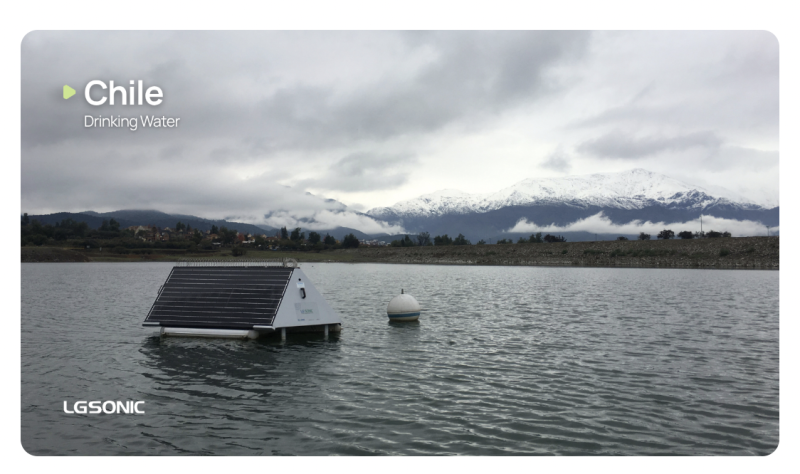
Aguas Andinas serves about 8.5 million people in Santiago. It built the Pirque Mega Ponds as a backup supply for unexpected events. Then it placed MPC-Buoys across the six ponds. The choice followed earlier results at its La Dehesa dam. Aguas Andinas reports no bloom threat since installation. It also describes how the utility relied on the buoys’ sensors and alerts during the COVID-19 lockdowns, when site visits were limited. In addition, the data helps it show compliance with Chile’s SEA rules. Read the Pirque, Chile, case study.
Quiñenco and Lloca, Chile: 38% in the first weeks
Essbio, one of Chile’s largest water utilities, deployed buoys in the Quiñenco reservoir to keep the source available for drinking water production. Algae levels fell by 38% in the first weeks. The buoy sensors measured the drop, and laboratory tests then confirmed it. “MPC-Buoy has maintained the availability of the water source,” said Francisco González Salas, Area Manager for the Arauco region at Essbio. After two years, Essbio added systems at its Lloca reservoir in late 2021. Read the Quiñenco, Chile, case study.
Quito airport, Ecuador: algaecide stopped
Mariscal Sucre International Airport in Quito keeps a 17 ha rainwater reservoir on its grounds. Algae pushed pH to 9 or 10, above the airport’s environmental targets, and the water smelled and turned green. Mechanical removal and algaecide doses needed ever more frequent repeats, so Quiport looked for a chemical-free option that would also protect the migratory birds that rest on the reservoir. It installed the MPC-Buoy in 2017. “We’ve stopped using chemicals for algae control,” said Maria Gabriela Landazuri, EHS Manager at Quiport. Total solids fell by 88%, and the airport later upgraded the system. Read the Quito, Ecuador, case study.
What about mining water?
Harmful algal blooms in Latin America are not limited to drinking water sources. Tailings dams and process water reservoirs hold stagnant, nutrient-rich water, which suits algae and clogs filters.
Vale, the world’s largest iron ore producer, faced recurring algal blooms and odour issues at its Barragem Sul tailings dam in Brazil. On 8 May 2021, Vale deployed MPC-Buoys for treatment and monitoring. The Netherlands Enterprise Agency (RVO) co-funded the project. Afterwards, sensor data and satellite imagery showed chlorophyll-a and phycocyanin holding steady at 0 to 3 µg/L. Read the Barragem Sul, Brazil, case study.
In Peru, a gold mining operation installed an MPC-Buoy system in 2020 in a reservoir that supplies drinking water at the site. The aim there is to keep filters running through the algae season. More on algae control in mining.

Case study
Valdesia reservoir, Dominican Republic
- 7 km² of water surface treated with ultrasound only.
- 87% reduction in chlorophyll-a in the first year.
- Two to three weeks until the first visible change.
Tags
Category: Case Studies
- Lake Management
- Reservoir
- Water Treatment Systems
- Ultrasound
- Algal Blooms
- Water, Waste Water Chemical & Treatment
- Argentina