Rainwater Harvesting Systems Technology ReviewThe Federal Energy Management Program (FEMP) identified rainwater harvesting systems as an alterna...
Published on by Water Network Research, Official research team of The Water Network
The Federal Energy Management Program (FEMP) identified rainwater harvesting systems as an alternative water technology that is relevant to federal facilities, is commercially available, and may offer an opportunity to offset freshwater use. This technology review is intended to provide agencies with key information to deploy rainwater harvesting systems.
Technology Description
Harvested rainwater can provide a source of alternative water to federal facilities. Alternative waters offset the demand for fresh surface water or groundwater, and can include harvested rainwater, captured condensate from air handling units, and reclaimed wastewater. Rainwater harvesting captures, diverts, and stores rainwater from rooftops for later use. Typical uses of rainwater include landscape irrigation, wash applications, ornamental pond and fountain filling, cooling tower make-up water, and toilet and urinal flushing. With additional filtration and disinfection, harvested rainwater can also be treated to potable standards to supplement municipal potable water supplies to facilities.
System Components
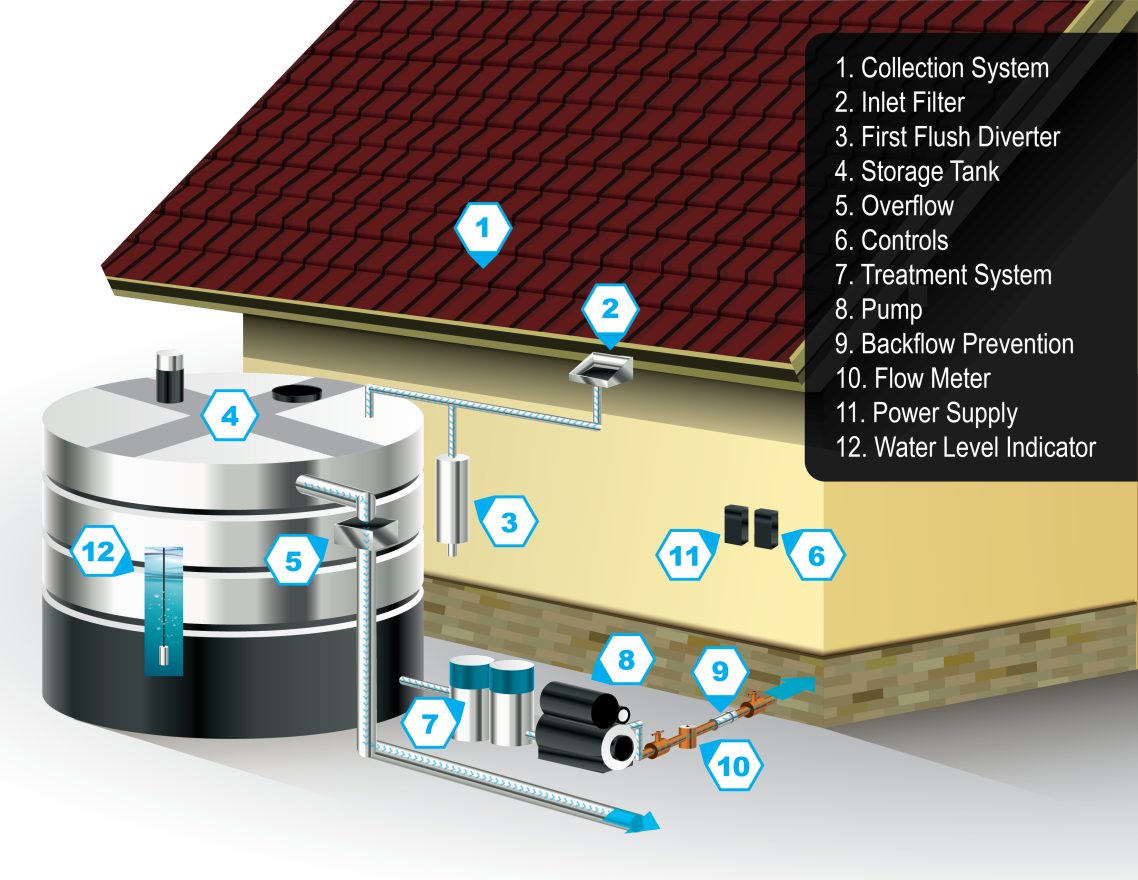
The major components of a rainwater harvesting system are displayed in Figure 1.
Graphic shows a schematic of a rainwater harvesting system next to the exterior of a house.
Figure 1. Components of a typical rainwater harvesting system
Collection system: Roof surface and gutters to capture the rainwater and send it to the storage system
Inlet filter: Screen filter to catch large debris
First flush diverter: Diverter that removes debris not captured by the inlet filter from the initial stream of rainwater
Storage tank: Storage tanks composed of food-grade polyester resin material approved by the U.S. Food and Drug Administration (FDA), which is green in color and helps to reduce bacterial growth
Overflow: Drainage spout that allows for overflow if the storage tank gets full
Controls: Control system that monitors water level and filtration system
Treatment system: Filtration and disinfection system that treats the water to non-potable or potable standards
Pump: Pump to move water through the system to where it will be used
Backflow prevention: Backflow preventer to ensure that under negative pressure water cannot flow backwards through the system into the make-up water system
Flow meter: Flow meter (with data logger) to measure water production
Power supply: Systems may use either conventional power sources or, to improve off-grid capabilities, alternative sources such as stand-alone or grid-tied solar systems
Water level indicator: Monitors the water level in the storage tank
Technology Considerations
The following are important considerations when planning for a rainwater harvesting project.
End Use: The intended end use of the harvested rainwater will determine the type of treatment equipment that the system will need.
Site location: Choose sites with adequate rainfall for the application. For more information, see the Rainwater Harvesting Tool.
Applications: Choose a location that has multiple applications that can use rainwater, such as vehicle wash, landscape irrigation, and dust suppression.
Size of catchment area (roof size): A larger roof area can capture significant amounts of precipitation, even in areas of low rainfall availability.
Rainwater storage capacity: Areas with less frequent precipitation may require larger tanks to provide more storage capacity between water recharge. An increased tank size will increase equipment cost.
Roof pitch and type: Roof material and pitch influence the amount of water that can be harvested. Lower-pitched roofs tend to catch more water than steeply pitched roofs. Smoother roof textures will facilitate runoff better than textured roofs.
Water rates: Areas with higher water rates will make rainwater harvesting projects more economically viable.
Permits: Rainwater harvesting permits may be required. Check with your local or state government. For more information, see the Rainwater Harvesting Tool.
Attached link
https://www.energy.gov/cmei/femp/rainwater-harvesting-systems-technology-reviewTaxonomy
- Water Harvesting
- Rainwater Harvesting
- Technology
- Water Harvesting
- Water Treatment Systems
- Rainwater Harvesting
- United States