Reading an MBBR carrier datasheet: the number that actually sizes the reactorAlmost every carrier datasheet leads with specific surface area, an...
Published by MF Cui, Sales Manager at Nuoweisen Environmental
Reading an MBBR carrier datasheet: the number that actually sizes the reactor
Almost every carrier datasheet leads with specific surface area, and it is the right number to start with. It is not the number that sizes the reactor.
The fill fraction is. Published carriers run 15–67% of reactor working volume, and that band is not a marketing range — it has two hard edges. Below it there is not enough biomass inventory to carry the load. Above it there is not enough mixing energy to keep every carrier moving freely, and a bed that stops moving is a bed that bridges.
So the sequence is:
1. Mass of pollutant removed per day = flow × (inlet − outlet) concentration.
2. Carrier volume = that mass ÷ the removal rate published for the series, in g/m3·day.
3. Divide by reactor working volume and check the answer lands inside 15–67%.
If it does not land inside, the honest conclusion is that the reactor volume is wrong for the load — not that a different carrier will rescue it.
Worked example: 1,000 m3/day, BOD from 300 to 30 mg/L is 270 kg/day. At 4,000 g/m3·day that is 67.5 m3 of carrier, which is a 22.5% fill in a 300 m3 reactor.
The check that gets skipped: run the same arithmetic for ammonia and take the larger of the two answers. Reactors sized on BOD alone are the usual reason a plant passes its carbon test and fails the ammonia one.
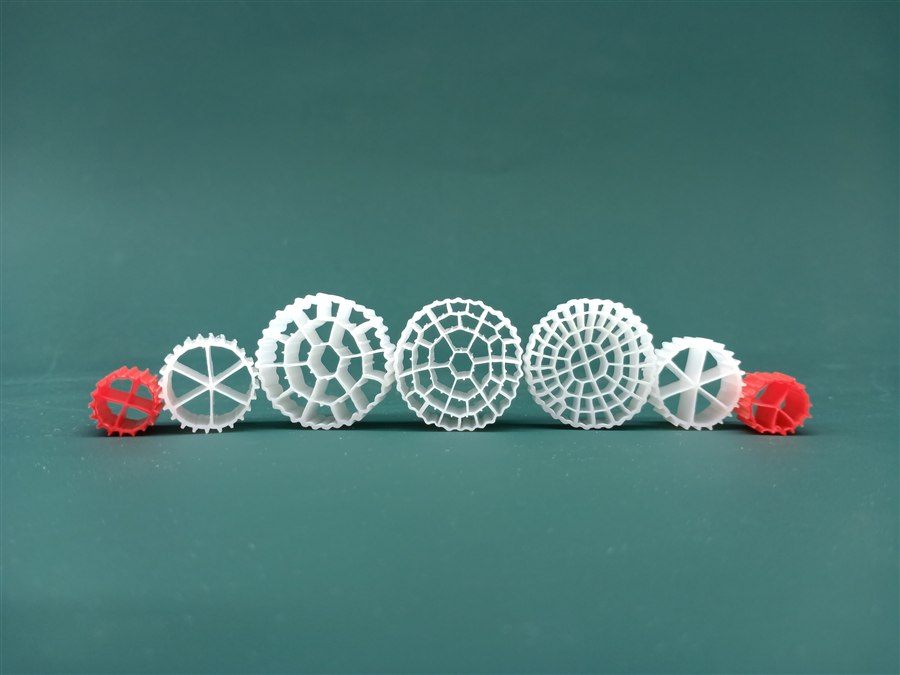
Published carrier specifications are here, including the K1–K5 size and surface-area ladder:
https://www.nuoweisengroup.com/mbbr-moving-bed-media
I work with Nuoweisen Environmental, which manufactures these carriers. Posting the method rather than a pitch, because the arithmetic is the same whatever brand ends up in the basin.