Modern intelligent technology helps breathe new life into Northwest China’s ancient Ningxia irrigation systemAcross the Ningxia Plain in north...
Published by Water Network Research, Official research team of The Water Network
Modern intelligent technology helps breathe new life into Northwest China’s ancient Ningxia irrigation system
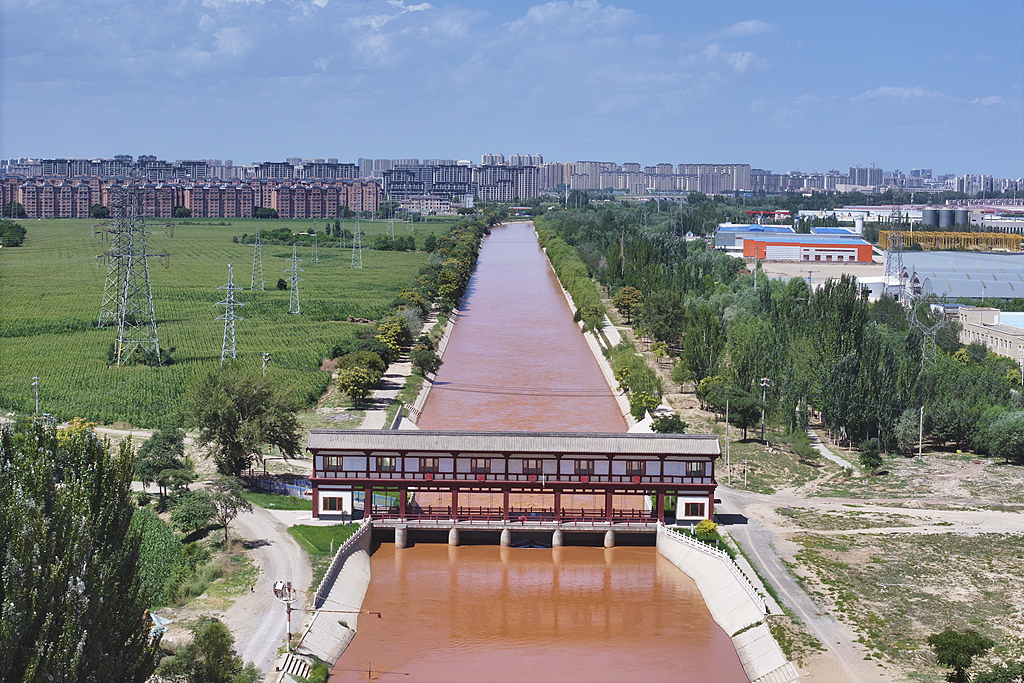
Across the Ningxia Plain in northwestern China, Yellow River water flows through channels like veins, reaching farmland. Along the Daqing Canal, water moves silently through newly rebuilt rectangular concrete flumes, its surface smooth as a mirror.
“The route of the canal hasn’t changed, but everything inside has,” said Bai Lu, head of the Qingtongxia Irrigation Area modernization project team under the Ningxia Hui Autonomous Region Water Conservancy Engineering Construction Center, crouching by the canal wall and tapping the sturdy concrete lining.
“In the past, it was earth canals or precast slab canals, and seepage and siltation were problems every year. Now it has been fitted with this ‘reinforced concrete shell’ — water is conveyed faster, and less is wasted.”
The Qingtongxia Irrigation Area is one of China’s six mega irrigation areas and an important part of the World Heritage-listed Ningxia Yellow River Ancient Irrigation System. In March 2025, the modernization project officially began, giving this ancient irrigation district a “digital brain.”
“An ancient irrigation area is not a museum relic. It is a tool that can be put to use,” Bai said.
Old channel upgraded
The Daqing Canal was first excavated during the reign of Emperor Kangxi of the Qing Dynasty (1644-1911), and its route has remained almost unchanged ever since. But the canal itself has long been under strain.
“At first, this section was just an earth canal, dug by hand, and seepage was serious,” said He Qiang, project manager of Section 6 of the Daqing Canal works. Later, hexagonal precast slabs were installed, but they did not last long either. Peeling, sand shedding, and frost heave damage became routine, and half the canal was clogged with silt. “The irrigation of 89,000 mu (59.33 hectares) of farmland was always under pressure. Every irrigation season, we had to rely on dredging boats,” he said.
Winter temperatures are too low for construction, leaving only two workable windows each year: more than 40 days before spring irrigation from March to April, and about 50 days after autumn irrigation from September to October. “All told, we only have about a hundred days a year to work,” He said.
This time, the team introduced a factory-based prefabricated reinforced concrete rectangular canal design. On site, rows of concrete components were neatly arranged. The prefabrication plant can produce and shape these components in 28 days before transporting them for assembly.
During installation, expansion waterproof strips are inserted between each slab, and epoxy resin mortar is applied to the outside as well. As He demonstrated with a level at the joint, the surface was flat and the seams were almost invisible. “It’s a double-layer anti-seepage system, and the concrete can fully withstand severe cold.”
He calculated that for a 5-kilometer canal, traditional cast-in-place construction would require 300 workers, while prefabricated assembly needs only 150. In addition, earthworks and prefabrication can proceed in parallel, without waiting for concrete to cure.
Across the Ningxia Plain in northwestern China, Yellow River water flows through channels like veins, reaching farmland. Along the Daqing Canal, water moves silently through newly rebuilt rectangular concrete flumes, its surface smooth as a mirror.
“The route of the canal hasn’t changed, but everything inside has,” said Bai Lu, head of the Qingtongxia Irrigation Area modernization project team under the Ningxia Hui Autonomous Region Water Conservancy Engineering Construction Center, crouching by the canal wall and tapping the sturdy concrete lining.
“In the past, it was earth canals or precast slab canals, and seepage and siltation were problems every year. Now it has been fitted with this ‘reinforced concrete shell’ — water is conveyed faster, and less is wasted.”
The Qingtongxia Irrigation Area is one of China’s six mega irrigation areas and an important part of the World Heritage-listed Ningxia Yellow River Ancient Irrigation System. In March 2025, the modernization project officially began, giving this ancient irrigation district a “digital brain.”
“An ancient irrigation area is not a museum relic. It is a tool that can be put to use,” Bai said.
Old channel upgraded
The Daqing Canal was first excavated during the reign of Emperor Kangxi of the Qing Dynasty (1644-1911), and its route has remained almost unchanged ever since. But the canal itself has long been under strain.
“At first, this section was just an earth canal, dug by hand, and seepage was serious,” said He Qiang, project manager of Section 6 of the Daqing Canal works. Later, hexagonal precast slabs were installed, but they did not last long either. Peeling, sand shedding, and frost heave damage became routine, and half the canal was clogged with silt. “The irrigation of 89,000 mu (59.33 hectares) of farmland was always under pressure. Every irrigation season, we had to rely on dredging boats,” he said.
Winter temperatures are too low for construction, leaving only two workable windows each year: more than 40 days before spring irrigation from March to April, and about 50 days after autumn irrigation from September to October. “All told, we only have about a hundred days a year to work,” He said.
This time, the team introduced a factory-based prefabricated reinforced concrete rectangular canal design. On site, rows of concrete components were neatly arranged. The prefabrication plant can produce and shape these components in 28 days before transporting them for assembly.
During installation, expansion waterproof strips are inserted between each slab, and epoxy resin mortar is applied to the outside as well. As He demonstrated with a level at the joint, the surface was flat and the seams were almost invisible. “It’s a double-layer anti-seepage system, and the concrete can fully withstand severe cold.”
He calculated that for a 5-kilometer canal, traditional cast-in-place construction would require 300 workers, while prefabricated assembly needs only 150. In addition, earthworks and prefabrication can proceed in parallel, without waiting for concrete to cure.
Tags
- Canals
- Irrigation
- Technology
- IT
- Irrigation System Design
- Irrigation & Water Management
- China