The ARAL SEA Was DEAD for 30 Years — Then Kazakhstan Did Something Nobody Expected!The Aral Sea was once the fourth-largest lake on Earth — ...
Published by Water Network Research, Official research team of The Water Network
The ARAL SEA Was DEAD for 30 Years — Then Kazakhstan Did Something Nobody Expected!
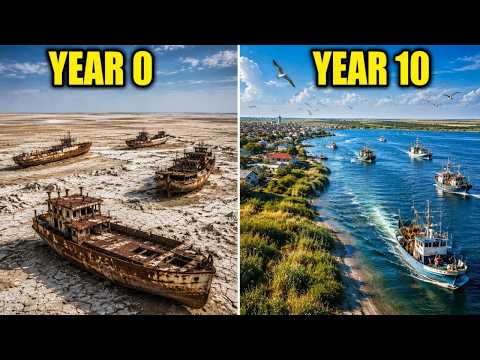
The Aral Sea was once the fourth-largest lake on Earth — and then, within a single generation, it vanished. By the early 2000s, what had been a thriving inland sea was a poisoned salt desert of rusting ships and dead harbors. Then Kazakhstan did something almost no one expected, and a part of the sea everyone had written off began to come back.
What this video covers:
Soviet irrigation projects diverted the two great rivers feeding the Aral Sea, and over a few decades the water collapsed, the fishing towns died, and toxic dust storms swept the exposed seabed. We trace how the disaster unfolded, why it became a byword for human-caused ecological catastrophe — and then how a single, focused piece of engineering changed the story in the north.
But here's the twist: the fix wasn't some vast, impossible re-flooding of the entire sea. It was a dam — the Kok-Aral Dam, completed in 2005 — that concentrated the remaining river flow into the smaller North Aral Sea. Within a few years the water rose, the salinity dropped, the fish returned, and the fishing communities along the northern shore came back to life. We cover what the recovery actually achieved, why the larger southern sea remains mostly lost, and what this divided outcome reveals about what restoration can and can't do.
This is the full story — the collapse, the science, and the surprising truth about the sea that came back from the dead. 🌊
What do you think — is the North Aral Sea proof that we can undo our worst mistakes, or a reminder of how much stays broken? Share your thoughts below.
The Aral Sea was once the fourth-largest lake on Earth — and then, within a single generation, it vanished. By the early 2000s, what had been a thriving inland sea was a poisoned salt desert of rusting ships and dead harbors. Then Kazakhstan did something almost no one expected, and a part of the sea everyone had written off began to come back.
What this video covers:
Soviet irrigation projects diverted the two great rivers feeding the Aral Sea, and over a few decades the water collapsed, the fishing towns died, and toxic dust storms swept the exposed seabed. We trace how the disaster unfolded, why it became a byword for human-caused ecological catastrophe — and then how a single, focused piece of engineering changed the story in the north.
But here's the twist: the fix wasn't some vast, impossible re-flooding of the entire sea. It was a dam — the Kok-Aral Dam, completed in 2005 — that concentrated the remaining river flow into the smaller North Aral Sea. Within a few years the water rose, the salinity dropped, the fish returned, and the fishing communities along the northern shore came back to life. We cover what the recovery actually achieved, why the larger southern sea remains mostly lost, and what this divided outcome reveals about what restoration can and can't do.
This is the full story — the collapse, the science, and the surprising truth about the sea that came back from the dead. 🌊
What do you think — is the North Aral Sea proof that we can undo our worst mistakes, or a reminder of how much stays broken? Share your thoughts below.
Tags
- Technology
- Sea Water Filtration
- Sea Water Desalinisation
- Clean Seas Campaign
- Kazakhstan