Steel Pipe Wall Thickness for Water Transmission SystemsBy: Dr. Hossein Ataei FarIn large-diameter water transmission pipelines, wall thickness ...
Published on by Hossein Ataei Far, Ambassador for Sustainability | EPC & PPP Strategist | Innovation-Driven & Open to New Ideas
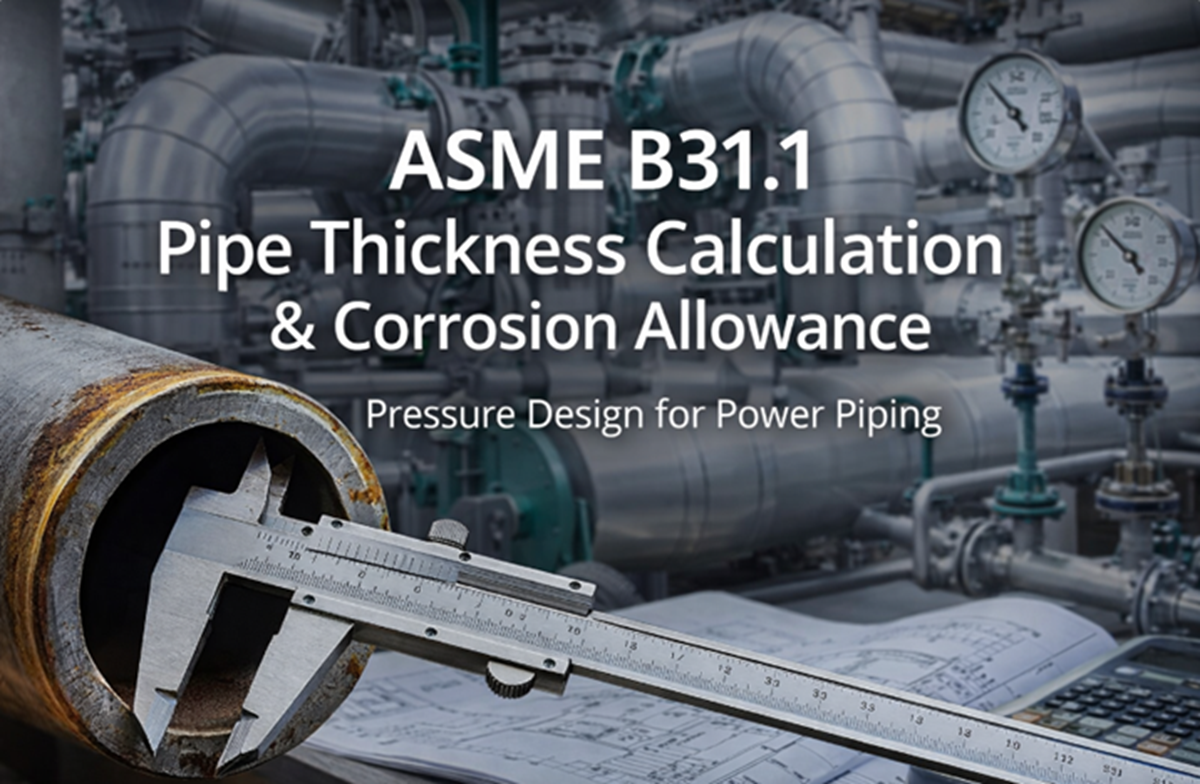
By: Dr. Hossein Ataei Far
In large-diameter water transmission pipelines, wall thickness is not merely a catalogue choice or a cost-driven decision.
It is a core design parameter that directly governs structural integrity, hydraulic reliability, service life, and long-term asset performance.
In practice, experienced pipeline engineers follow the same fundamental design philosophy adopted by
American Society of Mechanical Engineers (ASME) piping and pipeline codes.
The overall concept can be summarized as:
tₙ (nominal) ≥ t_required + Corrosion Allowance (CA) + Mill Tolerance
This simple expression hides several critical engineering judgments that are especially important in water transmission projects.
________________________________________
1. Required thickness – the pressure design thickness
The required thickness (t_required) is the minimum wall thickness needed to safely withstand the internal design pressure of the pipeline.
In ASME pipeline and piping codes (commonly used in water and utility projects for pressure integrity philosophy), this thickness is calculated from:
• Design pressure
• Outside diameter of the pipe
• Allowable stress of the steel at design temperature
• Weld joint efficiency
• Code-specific design coefficients
In simplified form, the ASME pressure design equation is expressed as:
t_required = (P × D) / (2 × S × E + P × Y)
Where:
• P = design pressure
• D = outside diameter
• S = allowable stress of pipe material
• E = weld joint efficiency
• Y = code coefficient
For water transmission systems, the most common mistake is to use only the normal operating pressure.
Best practice is to always base P on the maximum transient pressure, including surge and pump trip scenarios.
________________________________________
2. Why pressure design alone is not enough for water pipelines
Unlike many process plants, long-distance water transmission pipelines are usually governed by combined loading, not only internal pressure.
Experienced engineers always verify that the pressure-based thickness is compatible with:
• burial loads,
• traffic and live loads,
• soil-pipe interaction,
• installation conditions,
• vacuum and negative pressure cases.
In many real water projects, especially with:
• shallow cover,
• large diameters,
• weak soils,
structural criteria can govern the final wall thickness more than pressure.
________________________________________
3. Corrosion allowance (CA) – a life-cycle decision, not a fixed number
Corrosion allowance is the additional wall thickness added to compensate for expected material loss during service.
For water transmission pipelines, corrosion mechanisms are typically:
• external soil corrosion,
• stray current interference,
• internal corrosion caused by:
o low alkalinity,
o aggressive raw water,
o high dissolved oxygen,
o disinfection practices.
Unlike oil and gas systems, internal corrosion in potable or raw water lines is often underestimated.
Best industry practice for CA in water transmission
Instead of selecting a generic value (for example 1.5 mm or 3 mm), mature projects apply:
• soil corrosivity classification,
• groundwater resistivity,
• pH and chloride content,
• historical performance of nearby pipelines,
• coating and lining quality.
When high-performance external coatings and cathodic protection are applied, it is acceptable to reduce CA —
but only when protection reliability and inspection capability are clearly demonstrated.
________________________________________
4. Mill tolerance – the most overlooked factor
Steel pipes are manufactured with a negative wall tolerance.
Typical mill practice allows up to:
–12.5% below the nominal thickness
This means:
If a pipe is ordered as 10.0 mm nominal thickness, the delivered wall may legally be as low as 8.75 mm.
For water transmission pipelines with long design lives (40–75 years), failure to include mill tolerance can result in:
• local overstress at start of operation,
• reduced corrosion margin,
• unexpected fitness-for-service issues later in life.
Therefore, the correct engineering check is:
Minimum delivered thickness ≥ t_required + CA
________________________________________
5. Nominal thickness selection – what really governs the final value
In real water transmission projects, the selected nominal wall thickness must satisfy all of the following:
1. Pressure design requirement (ASME philosophy)
2. Corrosion allowance requirement
3. Mill tolerance
4. Structural and installation requirements
5. Constructability and availability of pipe sizes
The governing thickness is often:
• bending stress during lifting and stringing,
• ovalization during burial,
• buckling under external pressure in empty or partially filled pipelines.
________________________________________
6. Surge and transient pressures – critical for water systems
One of the most important differences between water transmission pipelines and most industrial pipelines is:
hydraulic transients dominate failure risk.
Best practice requires:
• full surge analysis,
• emergency shutdown scenarios,
• pump trip and power failure cases,
• valve closure time studies.
It is common to observe that:
the surge pressure governs t_required, not the steady-state pressure.
Ignoring this has led to many premature failures in large water projects worldwide.
________________________________________
7. Steel grade and allowable stress – practical guidance
For water transmission pipelines, commonly used steel grades are selected based on:
• weldability,
• toughness,
• availability,
• coating compatibility.
Higher-strength steel does reduce the pressure-based thickness.
However, best experience shows:
using higher grade steel does not always reduce the final wall thickness if structural and construction loads control the design.
Therefore, grade selection must be coordinated with:
• installation method,
• trench geometry,
• handling procedures.
________________________________________
8. Coatings, linings and their influence on thickness strategy
Modern water transmission pipelines typically use:
• internal cement mortar lining or polymer lining,
• external multilayer coatings.
From a life-cycle engineering viewpoint:
• coatings reduce corrosion rate,
• but do not eliminate the need for corrosion allowance unless supported by:
o cathodic protection,
o monitoring and inspection plans.
A well-designed corrosion protection system allows:
• optimization of CA,
• longer inspection intervals,
• lower total life-cycle cost.
________________________________________
9. Best practice thickness workflow for water transmission projects
A proven engineering workflow is:
1. Perform hydraulic design and surge analysis
2. Determine maximum design pressure
3. Calculate pressure-based thickness (ASME philosophy)
4. Define corrosion allowance using soil and water chemistry data
5. Apply mill tolerance
6. Check structural and installation load cases
7. Select the governing nominal thickness
8. Validate with constructability and supplier availability
________________________________________
10. Why this matters for asset management
From an asset management perspective, correct wall thickness selection directly impacts:
• failure rate in the first 10–15 years,
• rehabilitation strategy,
• leak and burst risk,
• total cost of ownership.
Poor thickness decisions often create hidden liabilities that appear only after:
• coating deterioration,
• hydraulic regime changes,
• system expansion.
________________________________________
Final engineering message
For steel water transmission pipelines, wall thickness is not simply a pressure design outcome.
It is a multi-disciplinary engineering decision integrating:
• ASME pressure design philosophy,
• corrosion engineering,
• structural and geotechnical behavior,
• surge and transient analysis,
• long-term asset strategy.
The correct approach is therefore:
Nominal wall thickness = engineering safety + durability + constructability + life-cycle value — not only pressure resistance.
This mindset is what differentiates routine pipeline design from resilient, long-life water infrastructure.
References:
1. American Society of Mechanical Engineers (ASME)
ASME B31.4 – Pipeline Transportation Systems for Liquids and Slurries.
ASME, New York.
2. American Society of Mechanical Engineers (ASME)
ASME B31.3 – Process Piping.
ASME, New York.
3. American Water Works Association (AWWA)
AWWA Manual M11 – Steel Pipe: A Guide for Design and Installation.
American Water Works Association, Denver, CO.
4. American Water Works Association (AWWA)
AWWA C200 – Steel Water Pipe, 6 in. (150 mm) and Larger.
American Water Works Association, Denver, CO.
5. American Water Works Association (AWWA)
AWWA Manual M45 – Fiberglass Pipe Design (used as reference for buried pipeline soil–structure interaction concepts and installation loads).
American Water Works Association, Denver, CO.
6. American Water Works Association (AWWA)
AWWA Manual M41 – Ductile-Iron Pipe and Fittings (structural and burial load background reference).
American Water Works Association, Denver, CO.
7. American Water Works Association (AWWA)
AWWA Manual M20 – Water Chlorination and Chloramination Practices and Safety.
American Water Works Association, Denver, CO.
8. NACE International (now AMPP)
Control of External Corrosion on Underground or Submerged Metallic Piping Systems (formerly NACE SP0169 / AMPP standards).
9. American Society of Civil Engineers (ASCE)
Guidelines for the Seismic Design of Buried and Submerged Pipelines.
10. https://mypipingnotes.com/asme-b31-1-pressure-design/