Coastal Aquifers Best Source for Desalination
Published by Water Network Research, Official research team of The Water Network in Academic
Groundwater from coastal aquifers is a better source for desalination than seawater
Researchers at Ben-Gurion University of the Negev (BGU) have determined that saline groundwater from coastal aquifers is a better alternative water source than seawater for reverse osmosis (RO) desalination due to reduced membrane fouling and pre-treatment costs.
The study was published in Environmental Science & Technology and conducted by researchers at the BGU Zuckerberg Institute for Water Research, the BGU Department of Geological and Environmental Sciences and the Israel Geological Survey.
 "Decision-makers in both California and Israel can use this research to seriously consider saline groundwater as a realistic alternative when planning future large-scale seawater desalination facilities," explains Dr. Roni Kasher, a senior lecturer in the BGU Zuckerberg Institute's Department of Desalination and Water Treatment. "In Israel, seawater desalination accounts for 60 percent of the total freshwater supply, so these findings are significant."
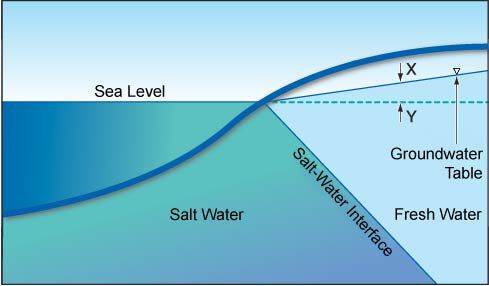
BGU researcher Shaked Stein adds," Saline groundwater results from seawater intrusion into coastal aquifers, shifting the fresh-saline water interface upward and landward, and replaces fresh groundwater with saline groundwater. The RO process in coastal aquifers will be helpful in restraining seawater intrusion."
Other saline groundwater benefits include consistent annual water temperatures, and lower levels of dissolved oxygen, silt density and phytoplankton. It also decreases the cost of desalination. The RO desalination process of seawater requires significant energy and large plant area by valuable shorefront property, both of which increase the product water cost.
"The study showed that aquifer filtration increases the feed water quality and reduces the need for extensive pre-treatment processes," explains Stein. "RO desalination with saline groundwater as feed water is also more efficient, with higher freshwater recoveries, less chemical use and maintenance, and therefore less overall operational costs."
Due to seasonal seawater characteristic fluctuations, Stein specifically recommends using saline groundwater in the summertime rather than seawater since the research identified higher membrane fouling in summer. "Salt rejection decreases in elevated temperatures due to changes in membrane permeability and mass transfer."
According to Dr. Kasher, "In our study, we used normal (vertical) wells to take samples from the saline groundwater. All the wells were a maximum of 300 feet (100 meters) from the shoreline. However, the water intake can be accomplished using several different types of wells."
Source: Phys.org
Read More Related Content On This Topic - Click Here
Tags
Category: Academic
- Groundwater
- Aquifer
- Sustainable Desalination
1 Comment
Subsurface intake systems extracting water from seabed/river bottom can provide a consistent supply of water without the fear of overexploitation of available quantity of water from coastal aquifers by industries & possible extraction of adjacent groundwater resources or freshwater mixing from adjacent groundwater into the saltwater aquifer. Apart from this minor possibility of misutilization of resources by industries, the current problem of environmentalist nonsupportive on extracting water from coastal aquifers are the few problems to be faced by industries on commercial utilization. However, it is an eco-friendly technology. Great!
Published by Prince Prakash Jeba Kumar J, Scientist at National Institute of Ocean Technology