India’s Water Future
Published by Asit Biswas, Distinguished Visiting Professor, University of Glasgow in Academic
Chapter of the book ‘Insights on Global Challenges and Opportunities for the Century Ahead’
(V. D. Reddy, K. V. Rao and K. R. Krishna (Editors), 2017, Osmania University, Hyderabad, pages 169–175)
Asit K. Biswas and Cecilia Tortajada
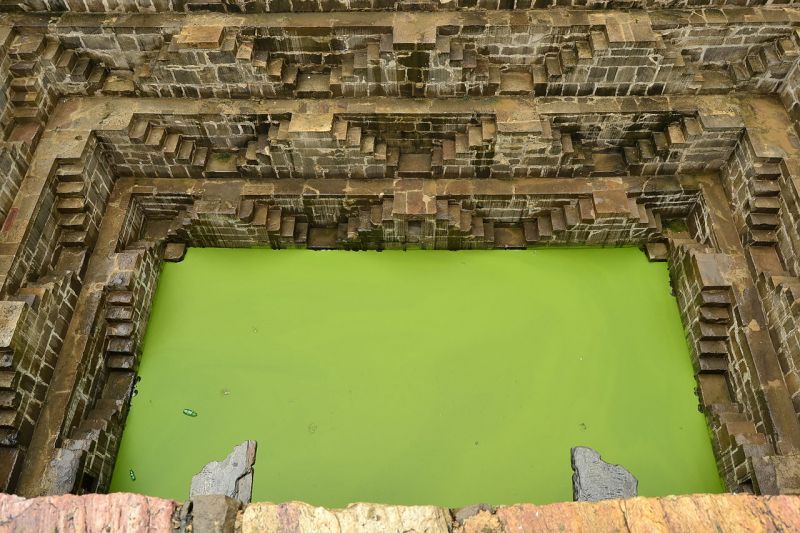
Chand Bori
Introduction
Water planning in India has been on an unsustainable path for centuries. In the 16th century, Mughal Emperor Akbar decided to build a new capital in Fatehpur Sikri (City of Victory). In 1589, Robert Fitch, one of the earliest English travellers to India, noted that Agra and Fatehpur Sikri were “two great cities, either of them much greater than London and more populous”.
The history of the new capital was not so auspicious. Akbar used it only for 13 years and then abandoned it completely to return to his old capital on a permanent basis. The main reason was very simple. There was not enough water in Fatehpur Sikri in the arid plains of northern India to function as an effective capital. Fatehpur Sikri is a magnificent monument to India’s poor water planning.
Over the centuries India’s water planning has improved only incrementally whereas its drivers of water uses have increased exponentially.
Consequently, the complexities and magnitudes of water management in the country have steadily increased. Sadly, even though India has now become a major global economy power, its water management practices and processes are at least 50 years behind time.
Thus, not surprisingly, all over the country, there are continuous signs of water stress because of scarcity or excess of water, as well as its quality and reliable availability over both space and time.
Read and download full paper from the attachment
Tags
Category: Academic
- Policy
- Water Access
- Research
- Water Supply
- Water Management
- Infrastructure
- Governance & Planning
1 Comment
@ India's Water Future
Dear All,
I trust this e-mail finds you all in the best of your health and spirit.
I have pleasure to inform you all that I have authored a book entitled "Better Groundwater Governance Only Can Ensure Sustained Water Supply", published by Lambert Academic Publishing, Germany.
For water security point of view, I request you all to give wide publicity about this book, because, I think public (including all stakeholders) by an large has taken water for granted.
The book is ready to be released at the price of 49.90 € Euro.
You can get printed copies of the book with up to 70% discount. This one time offer is valid only until 2017-06-10.
To place your order, please follow the link:
Blurb: All countries are confronted with water scarcity of varying types. The daunting biggest challenge for the authorities is in protecting groundwater from depletion and pollution, and making sound managing decisions on complex issues/activities that may affect water supply at local and basin scale. For short-term situation management when water supplies are affected, the managers usually adopt approaches, which involve eliminating immediate, unacceptable impacts on human and the environment, groundwater-use restrictions, regulation, balancing time and resources. However, these may require more research, time, regulations, funding, technology, etc., and be expensive/complex.This book identifies the issues that affect water supply; and makes scientific endeavors to improve all stakeholders’ awareness and understanding of real groundwater problems, and suggests governance approaches by relevant policies, with strong peoples’ participation efforts by behavioral change. The analysis may be especially useful to professionals in water governance and communications for long-term solutions to ensure sustained water supply, reducing costs and implementing water resources protection strategies, for public benefit.
Prof. Partha Sarathi Datta,
Independent Consultant on Water and Environment, (Former Project Director, Nuclear Research Laboratory, IARI), New Delhi.
E-mail: psdatta1950@gmail.com
Published by Prof. Partha Sarathi Datta, Independent Consultant on Water & Environment