Nature’s Desalination: with any electricity consumption, without any brine productionDid you know that, the estimated size of the global desal...
Published by Madhukar Swayambhu, Inventor, Water Hero, TED Speaker, Columnist, Researcher, Trainer
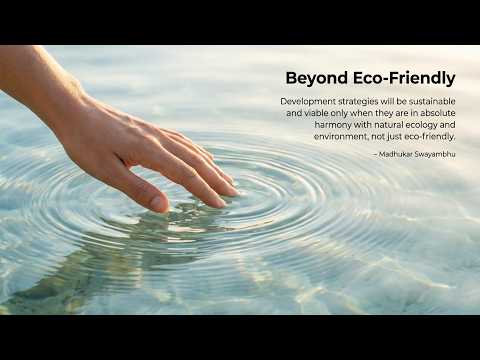
Nature’s Desalination: with any electricity consumption, without any brine production
Did you know that, the estimated size of the global desalination market spans between USD 21.9 Billion and USD 30.19 Billion in 2026, depending on whether the scope isolates specific processing equipment or tracks the entire technologies sector. Driven by accelerating freshwater scarcity and population growth, the market is undergoing a notable expansion phase with a projected valuation nearing USD 43 Billion to USD 59.34 Billion by the mid-2030s. There are an estimated 22,000 operational desalination plants running globally across 177 countries.
We all know that 72% of the planet is covered with Water, still only 3% of this Water volume is sweet drinkable Water, rest all is saline or marine Water. Let’s understand how does this water get saline and how does it get desalinated? Nature has three parallel cyclic process going on for everything that we see around, that’s creation, rearing and consumption. Everything moves in a cycle, like we have Nitrogen Cycle, Carbon Cycle, Water Cycle and so on.
It’s true for all natural processes including life and death, then be it for single celled organisms or single atom of an element or complex organism like human being or complex molecules like benzene.
Therefore, salts are no exceptions. Let's explore the natural process of salination of Water, Desalination of Water and understand where does the salt go, in this video https://youtu.be/aYyXrIZ2b-Y
Watch it, like it, share it – as you like, but do share feedback
Did you know that, the estimated size of the global desalination market spans between USD 21.9 Billion and USD 30.19 Billion in 2026, depending on whether the scope isolates specific processing equipment or tracks the entire technologies sector. Driven by accelerating freshwater scarcity and population growth, the market is undergoing a notable expansion phase with a projected valuation nearing USD 43 Billion to USD 59.34 Billion by the mid-2030s. There are an estimated 22,000 operational desalination plants running globally across 177 countries.
We all know that 72% of the planet is covered with Water, still only 3% of this Water volume is sweet drinkable Water, rest all is saline or marine Water. Let’s understand how does this water get saline and how does it get desalinated? Nature has three parallel cyclic process going on for everything that we see around, that’s creation, rearing and consumption. Everything moves in a cycle, like we have Nitrogen Cycle, Carbon Cycle, Water Cycle and so on.
It’s true for all natural processes including life and death, then be it for single celled organisms or single atom of an element or complex organism like human being or complex molecules like benzene.
Therefore, salts are no exceptions. Let's explore the natural process of salination of Water, Desalination of Water and understand where does the salt go, in this video https://youtu.be/aYyXrIZ2b-Y
Watch it, like it, share it – as you like, but do share feedback